
Hazardous Spill Prevention & Control — India
Stop the Spill
Before It Becomes
a Crisis.
A hazardous spill not contained in the first two minutes can become an environmental incident, a regulatory notification, a worker hospitalisation, or worse. NIST Global's Hazardous Spill Prevention & Control Training equips your workforce to prevent spills before they happen — and to respond with speed, confidence, and the right equipment when they do. Customised to your site, your chemicals, and your spill kits.
Spill response training built for your site and chemicals
The Reality
Why Chemical Spills Escalate Beyond First-Response Capacity
Having spill kits on site and SDS files in a binder does not constitute spill response capability. These are the gaps between compliance equipment and competent response.
Spill kits opened — but incorrectly used
Most sites have spill kits. Most workers have never practised deploying them. In a real spill, untrained employees open the wrong kit for the chemical type, apply absorbents before containing the spill, or contaminate themselves during response.
Drain contamination — the invisible escalation
Floor drains are the fastest path from a contained spill to an environmental incident. In most uncontrolled spill responses, drain coverage is the last thought — by which time the chemical has already entered the drainage system and triggered regulatory notification obligations.
Wrong PPE delays response
Employees who are uncertain about required PPE will either delay response while locating equipment or, worse, approach the spill without adequate protection. Both outcomes are dangerous. Response PPE must be pre-selected and practised — not decided under pressure.
MSIHC reporting obligations — unknown to respondents
MSIHC Rules 1989 require notification to the Chief Inspector of Factories and environmental authorities for reportable chemical releases. Most frontline responders are unaware of these obligations — creating compliance gaps that emerge only during post-incident investigations.
From Spill Risk to Controlled, Confident Response
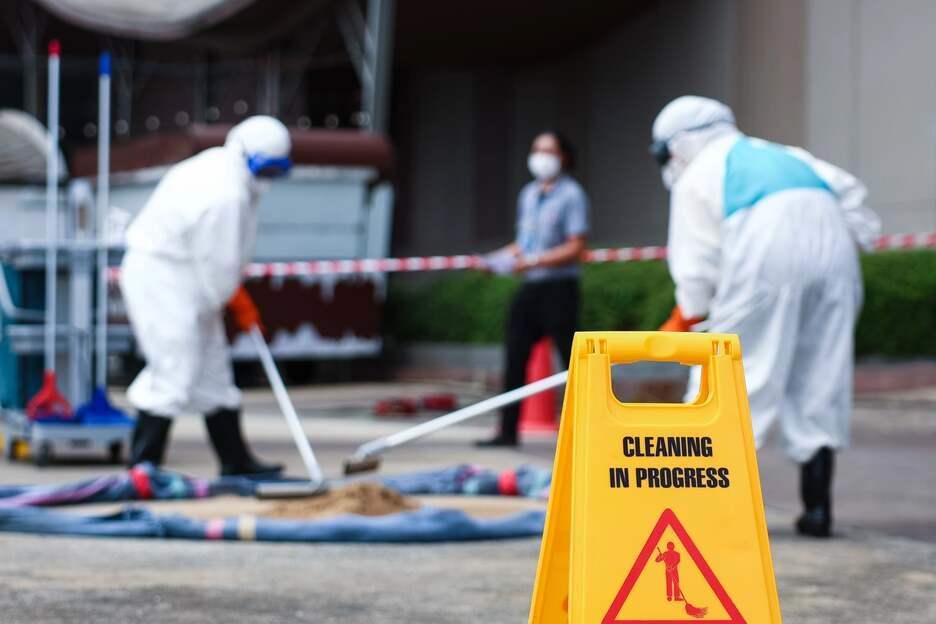
NIST Global's Hazardous Spill Prevention & Control Training is a practical, scenario-driven programme with two integrated components: spill prevention — identifying the conditions, storage failures, and handling errors that cause spills before they occur — and spill response — deploying the correct equipment, PPE, and procedures to contain and clean up a hazardous release safely and compliantly.
The programme covers the full spill response lifecycle: identification, alerting, containment, PPE deployment, clean-up by chemical type, decontamination, waste disposal, regulatory reporting, and incident documentation. Practical exercises with actual spill kit equipment are a core component — building the muscle memory that makes the difference between an effective two-minute response and an escalated environmental incident.
Every NIST Global spill training programme is fully customised to the specific chemicals at your facility, your spill kit inventory, your drainage and bunding system, and your regulatory notification obligations — ensuring participants practise with the tools and procedures they will actually use in a real spill event.
Compliant with MSIHC Rules 1989, Environment Protection Act 1986, Factories Act 1948, NDMA Chemical Disaster Guidelines, and ISO 45001 emergency preparedness requirements.
Get a Customised Spill Response Programme →The RACE Protocol — Four Steps That Control Any Hazardous Spill
Every effective spill response follows a structured sequence. The RACE protocol gives responders a clear, memorable framework for acting correctly under pressure — from first recognition through to safe clean-up and regulatory reporting.
Identify, Assess & Decide
- Identify that a spill has occurred
- Determine the chemical using GHS label or SDS
- Assess quantity, spread direction, and drain proximity
- Identify ignition sources, ventilation, and proximity hazards
- Decide: within trained response capacity, or escalate?
- Locate the correct SDS for emergency guidance
Notify & Mobilise Response
- Alert colleagues and clear the immediate area
- Notify the EHS Officer and ERT
- Activate site emergency alarm if required
- Call emergency services for major releases
- Inform control room and facility management
- Ensure no one else approaches without PPE
Stop the Spread, Protect Drains
- Don correct PPE before approaching spill
- Cover floor drains immediately with drain plugs or socks
- Place absorbent booms around spill perimeter
- Stop or isolate the source if safe to do so
- Deploy correct spill kit for the chemical type
- Prevent spill from entering drainage or waterways
Clean Up, Decontaminate & Document
- Apply absorbent media over contained spill area
- Neutralise acids/alkalis where appropriate and safe
- Package contaminated waste in approved containers
- Decontaminate personnel, equipment, and affected area
- Complete incident report and MSIHC notification if required
- Replenish spill kits and investigate root cause
Right Spill Kit for Every Chemical Type
Using the wrong spill kit for the chemical type can spread contamination, intensify the hazard, or leave the spill inadequately absorbed. NIST Global's training builds hands-on competency in selecting and deploying each kit type correctly.
The universal spill kit uses grey or white absorbent materials that absorb most liquids — water-based chemicals, oils, fuels, coolants, and many industrial solvents. It is the most commonly deployed first-response kit in general manufacturing, warehousing, and non-specialist chemical environments. Universal kits do not neutralise chemicals — they absorb them. Contaminated absorbents must be disposed of as hazardous waste. Not suitable for concentrated acids, alkalis, or reactive chemicals — use a chemical or acid/alkali kit for these.
- Grey loose absorbent granules or pads
- Absorbent socks / booms for perimeter control
- Drain covers and drain plugs
- Nitrile gloves (inner) and chemical-resistant gloves (outer)
- Chemical splash goggles
- Polypropylene disposal bags with ties
- Hazardous waste labels
- Instruction card and response guide
- General industrial liquids, coolants, water-based solutions
- Fuels and lubricating oils (on hard surfaces)
- Minor solvent spills in non-specialist areas
Oil-only kits use white hydrophobic absorbents that repel water while absorbing petroleum-based liquids — fuels, lubricating oils, diesel, hydraulic oil, and mineral spirits. The hydrophobic property makes them specifically suited for use on water surfaces (such as drains, pits, or open water), where universal kits would absorb both the oil and the water. They are also ideal for outdoor spill containment where rainwater is present. Oil-only kits do not absorb water-soluble chemicals, acids, or alkalis — these require a universal or chemical kit.
- White hydrophobic absorbent pads and rolls
- White hydrophobic absorbent socks / booms
- Loose white absorbent granules
- Drain covers and oil-only drain plugs
- Oil-resistant gloves and goggles
- Disposal bags and hazardous waste labels
- Instruction card
- Fuel, diesel, hydraulic oil, and lubricant spills
- Oil spills on water surfaces (drains, pits, outdoor areas)
- Engine bays, fuel storage areas, and vehicle maintenance
Chemical hazmat kits are designed for spills involving aggressive, toxic, corrosive, or flammable chemicals — including solvents, reactive intermediates, process chemicals, and substances with high inhalation or skin contact risk. They include higher-specification PPE (chemical-resistant suit or splash suit, inner and outer gloves, full face shield) appropriate for the hazard level. The absorbent media in chemical kits is typically more chemically resistant than standard grey absorbents. Match the PPE provided in the kit to the specific chemical SDS Section 8 requirements — some toxic chemicals require respiratory protection beyond what is included in a standard kit.
- Chemically resistant absorbent pads and socks
- Loose absorbent granules — chemically resistant grade
- Drain covers and plugs
- Chemical splash suit or apron
- Inner nitrile and outer chemical-resistant gloves
- Full face shield and chemical splash goggles
- Polypropylene disposal bags — heavy duty
- Hazardous waste labels and incident report card
- Solvents, toxic chemicals, process intermediates
- Chemicals with significant inhalation or skin contact risk
- Spills in chemical processing, pharma, and laboratory environments
Acid and alkali kits contain specific neutralising agents alongside absorbents — sodium bicarbonate for acid spills, citric acid for alkali spills — and pH indicator strips to confirm neutralisation before clean-up. Neutralisation is used to convert a corrosive hazard to a less dangerous salt, reducing the risk during clean-up and simplifying waste disposal. Neutralisation should only be performed by trained personnel — exothermic reactions, heat generation, and gas evolution can occur if the neutralising agent is applied incorrectly. The kit also includes high-specification PPE appropriate for corrosive chemical contact: full face shield, butyl rubber or neoprene gloves, and chemical-resistant apron.
- Sodium bicarbonate (acid neutraliser)
- Citric acid powder (alkali neutraliser)
- pH indicator strips
- Acid/alkali-resistant absorbent pads and socks
- Drain covers and plugs
- Butyl rubber or neoprene gloves (acid/alkali resistant)
- Full face shield
- Chemical-resistant apron or splash suit
- Heavy-duty disposal bags and neutralised waste labels
- Sulphuric, hydrochloric, nitric, and other mineral acid spills
- Sodium/potassium hydroxide and other caustic alkali spills
- Battery acid spills in manufacturing and EV environments
Chemical-Specific Spill Response Procedures
The correct response procedure varies significantly by chemical type. NIST Global's training covers the key differences — ensuring responders don't apply a one-size-fits-all approach to chemically distinct hazards.
Immediate Response Actions
- 1Identify acid type and concentration from GHS label or SDS Section 2
- 2Alert others — acids produce fumes; clear the area of non-responders
- 3Don acid-resistant PPE: butyl/neoprene gloves, face shield, apron
- 4Cover floor drains immediately with drain plugs or absorbent socks
- 5Place absorbent booms around spill perimeter to contain spread
- 6Apply sodium bicarbonate (acid kit) — add slowly, observe for reaction
- 7Check pH with indicator strips — continue until pH 6–8
Clean-Up & Documentation
- 8Apply absorbent pads over neutralised area; scoop into approved waste containers
- 9Rinse affected area with water and check final pH
- 10Decontaminate PPE and personnel; check skin and eyes for contact
- 11Label waste containers: "Neutralised Acid Waste — Hazardous"
- 12Arrange compliant disposal through licensed hazardous waste contractor
- 13Complete incident report; assess MSIHC notification requirement
- 14Replenish acid spill kit; investigate root cause of spill
Immediate Response Actions
- 1Identify alkali type from GHS label or SDS — caustics generate heat on contact with water
- 2Alert and clear area; concentrated alkali fumes and aerosols are hazardous
- 3Don alkali-resistant PPE: butyl/neoprene gloves, face shield, apron
- 4Cover floor drains — alkalis are highly damaging to aquatic environments
- 5Contain spread with absorbent booms; do not apply water to concentrated NaOH
- 6Apply citric acid powder (alkali kit) slowly — observe for heat generation
- 7Check pH with indicator strips — neutralise to pH 6–8
Clean-Up & Documentation
- 8Apply absorbents to neutralised residue; scoop into labelled waste containers
- 9Rinse area with water; check eye and skin contact on all responders
- 10Decontaminate equipment and PPE; dispose of in hazardous waste stream
- 11Label waste: "Neutralised Alkali Waste — Hazardous"
- 12Arrange compliant disposal; document for MSIHC/environmental compliance
- 13Complete incident report and assess regulatory notification requirements
- 14Replenish alkali spill kit; conduct root cause investigation
Immediate Response Actions
- 1Identify flash point and flammability class from SDS Section 9
- 2IMMEDIATELY eliminate all ignition sources — switch off electrical equipment
- 3Ventilate the area — open doors/windows if safe to do so
- 4Do NOT use fans or motorised equipment that could spark in vapour zone
- 5Alert and clear non-essential personnel from the area
- 6Don PPE: chemical-resistant gloves, goggles — no static-generating materials
- 7Cover drains; apply loose absorbent granules — do NOT use absorbent pads that could generate static
Clean-Up & Documentation
- 8Collect contaminated absorbent into metal or antistatic containers — not standard plastic bags
- 9Keep containers sealed — flammable vapour build-up in closed containers is a secondary hazard
- 10Remove containers from building immediately to a safe external area
- 11Continue ventilating until atmospheric monitoring confirms vapour below LEL
- 12Complete incident report; assess fire service and environmental notification
- 13Arrange compliant solvent waste disposal through licensed contractor
- 14Review ignition source controls and storage arrangements
Immediate Response Actions
- 1Identify oil type — mineral oil, synthetic, vegetable, or fuel — from labelling
- 2Alert and rope off the spill area — oil creates significant slip hazards
- 3Don oil-resistant gloves and goggles; check if fuel component is present (flash point)
- 4Cover floor drains with oil-only drain plugs or absorbent socks immediately
- 5Apply oil-only absorbent booms around spill perimeter
- 6Apply oil-only absorbent pads or loose granules over spill
- 7For outdoor or surface water spills, use oil-only booms to contain spread
Clean-Up & Documentation
- 8Collect saturated absorbents into approved heavy-duty waste containers
- 9Apply degreaser or detergent to residual film; rinse with water if drain is protected
- 10Check drainage system downstream for contamination
- 11Label waste containers: "Oily Waste — Hazardous"
- 12Arrange disposal through licensed oil waste contractor
- 13Complete incident report; notify environmental authority if water body affected
- 14Inspect source — pipe seal, storage tank, or hose connection failure
Immediate Response Actions
- 1Identify gas from detector alarm or SDS — do NOT enter to identify without SCBA
- 2IMMEDIATELY initiate area evacuation — upwind and to high ground for heavier-than-air gases
- 3Eliminate ignition sources for flammable gases (LPG, methane, hydrogen)
- 4Contact emergency services — gas leak response typically requires ERT with SCBA
- 5Establish a safety perimeter — use wind direction to position personnel
- 6Activate atmospheric monitoring at perimeter to track dispersion
- 7Do NOT re-enter without supplied-air or SCBA respiratory protection
Post-Stabilisation Procedures
- 8Once source is isolated, continue monitoring until gas level falls below TLV/OEL
- 9Ventilate area; confirm atmospheric clearance before re-entry
- 10Check all personnel for exposure symptoms; apply first aid per SDS Section 4
- 11Notify MSIHC authorities and CPCB for reportable toxic gas releases
- 12Complete incident report with atmospheric monitoring data attached
- 13Conduct root cause investigation — source valve, pipe, or seal failure
- 14Review gas detection system coverage and ERT SCBA readiness
Spill Prevention Strategies — Stop It Before It Starts
The most effective spill response is prevention. NIST Global's programme dedicates significant time to the engineering controls, storage improvements, and operational practices that prevent spills from occurring in the first place.
Secondary Containment & Bunding
Bunds, drip trays, and spill pallets that contain released liquid within a defined area before it reaches drains or spreads. Correct bund capacity (110% of largest container volume), inspection of bund integrity, and drainage valve management to prevent discharge during rainfall events.
Chemical Storage Compatibility & Segregation
Preventing storage-triggered reactions through correct chemical segregation — acids from alkalis, oxidisers from flammables, water-reactives in sealed dry areas. Quantity limits, stack height controls, and regular storage area inspection to identify deteriorating containers and labels.
Safe Transfer & Decanting Procedures
Supervised, standardised transfer procedures for high-risk chemical operations — overfill prevention (fill to 85–90% capacity), drip tray deployment during transfers, hose connection inspection before pressurisation, and two-person verification for transfers of high-hazard chemicals.
Preventive Maintenance & Inspection
Regular inspection of pipe seals, pump packing, valve integrity, container condition, and bunding. Chemical compatibility checks for gaskets, seals, and hoses — many spills originate from incompatible seals dissolving in contact with the chemical they were designed to contain.
Early Leak Detection Systems
Floor drip trays, level alarms, leak detection sensors, and CCTV monitoring in chemical storage and processing areas. Early detection reduces spill volume and response time — the two most critical factors in preventing a minor release from becoming a major incident.
Correct Labelling & Site Chemical Register
Maintaining an up-to-date site chemical register and SDS library, ensuring all containers are correctly labelled under GHS at all times, and communicating chemical hazard information to all workers — including contractors — who enter chemical handling or storage areas.
What Employees Will Be Able to Do After Training
Observable, measurable competencies — covering prevention, response, clean-up, and regulatory compliance.
Identify and Control Spill Risks Proactively
Recognise storage, handling, and equipment conditions that create spill risk — and report or correct them before a release occurs. Apply chemical storage compatibility and segregation principles to the actual chemicals at their facility.
Execute the RACE Protocol Under Pressure
Apply the Recognise-Alert-Contain-Evaluate protocol correctly in a simulated spill scenario — making correct decisions about PPE, containment sequence, drain protection, and escalation without hesitation or role confusion.
Select and Deploy the Correct Spill Kit
Select the appropriate spill kit for the chemical type involved — universal, oil-only, chemical hazmat, or acid/alkali — and deploy it correctly: booms first, drain protection before absorbents, neutralisation sequence for acid/alkali kits.
Complete Safe Clean-Up and Decontamination
Apply correct clean-up procedures for each chemical type, complete personnel and equipment decontamination, package contaminated waste compliantly, and verify environmental clearance before removing spill barriers and drain plugs.
Complete Regulatory Reporting and Documentation
Complete a spill incident report accurately and completely, identify when MSIHC Rules notification or environmental authority reporting is required, and understand the consequences of failure to report a qualifying chemical release.
Protect Drains, Water, and Soil
Prioritise drain protection in every spill response — understanding that preventing entry into the drainage system is the most important single action in limiting the environmental and regulatory consequences of a hazardous release.
Benefits for Every Level of Your Organisation
From the frontline worker responding to a spill to the EHS manager managing regulatory compliance — spill response training delivers measurable value at every level.
MSIHC & EPA Compliance Documentation
Auditable training records demonstrating competency in spill response planning and execution — supporting compliance with MSIHC Rules 1989 and EPA 1986 requirements for trained personnel and documented emergency procedures during regulatory inspections.
Site-Specific Response Plans
Training built around your actual spill kits, drainage layout, bunding system, and chemical inventory — not a generic response exercise. Participants practise with the equipment at their facility, following the emergency procedures mapped to their specific site.
Reduced Regulatory & Environmental Liability
MSIHC Rules 1989 and the EPA 1986 impose significant penalties for inadequately managed chemical releases. Demonstrable, site-specific spill response training substantially reduces regulatory liability following an incident investigation.
Confidence to Respond — Not Freeze
Practical spill kit deployment training replaces the uncertainty and panic that characterises untrained responses — giving employees a clear protocol, the right equipment, and the hands-on experience to act effectively in the critical first minutes of a chemical spill.
Protection From Chemical Exposure
Understanding which PPE to don before approaching a spill — and practising donning it quickly and correctly — prevents the improvised responses that lead to skin and eye chemical contact during spill response events.
Clearer Roles During Spill Events
Training establishes clear role assignments during spill response — immediate responder, EHS notification, ERT activation, drain protection, and documentation — reducing the "everyone looks at everyone else" confusion that delays containment.
Dramatically Reduced Spill Incident Costs
An uncontrolled chemical release generates costs across multiple dimensions — environmental remediation, regulatory fines, lost production, equipment decontamination, waste disposal, legal fees, and reputational damage. Prevention and early containment training costs a fraction of any one of these.
Environmental & ESG Protection
Preventing chemical releases from entering drainage systems and water bodies protects soil, water, and air quality — reducing environmental liability and supporting ESG performance metrics increasingly scrutinised by investors, clients, and regulators.
Operational Continuity & Business Resilience
A contained minor spill that is cleaned up in 30 minutes has a fundamentally different business impact from an uncontrolled release that triggers environmental authority investigation, production shutdown, and regulatory enforcement action.
How NIST Global Delivers Hazardous Spill Prevention & Control Training
Spill response cannot be taught from slides. Every NIST Global session includes hands-on spill kit deployment exercises, PPE practice, and simulated spill scenarios using your site-specific equipment and chemicals.
NIST Global by the Numbers
Trusted Across India's Most Demanding Industries
18+ years of exclusive HSE focus delivering measurable outcomes across 500+ organisations and 35+ industry sectors.
Hazardous Spill Training Is Essential For
Anyone who works in an environment where a chemical spill could occur — or who would be expected to respond to one — needs this training. This explicitly includes contract workers and maintenance personnel.
Chemical Handlers & Process Operators
Primary audience — employees directly handling, transferring, or processing hazardous chemicals who need both prevention competency and full first-response capability.
ERT Members — Spill Response Roles
ERT members designated as spill responders requiring advanced kit deployment, PPE for aggressive chemicals, and decontamination competency beyond general awareness.
Maintenance & Utility Operators
Maintenance personnel who encounter chemical releases during equipment cleaning, pipe work, pump replacement, and decommissioning — often without routine chemical handling awareness.
Logistics & Warehouse Staff
Personnel receiving, storing, and dispatching chemical consignments — exposed to container damage spills during loading, unloading, and racking operations.
Laboratory Technicians
Lab staff working with a wide range of chemicals in smaller quantities — where spill response procedures, fume hood containment, and body wash/eyewash station use must be second nature.
Supervisors, Contractors & Temporary Staff
All supervisors managing chemical work areas, and all contract or temporary workers handling or working near hazardous chemicals. MSIHC Rules obligations apply to all persons at the facility.
Spill Response Training for Every High-Chemical-Risk Industry
The chemicals, spill kit types, and response procedures differ dramatically across industries. NIST Global customises scenario content, SDS exercises, and kit deployment practice to your specific sector.
Chemical & Petrochemical
Pharmaceutical & Biotech
Oil, Gas & Refining
Manufacturing & Industrial
Laboratories & R&D
Transport & Logistics
Pair Spill Training with NIST Global's Chemical Safety Suite
Hazardous Spill Prevention & Control Training is most effective as part of a broader chemical safety programme. Pair it with Chemical Safety Training, First Aid, and ERT & Mock Drill training for complete site-level emergency readiness.
Real Experiences from Organisations We've Trained
Trusted by EHS leaders and safety professionals across India's most demanding chemical and industrial environments.
Frequently Asked Questions About Hazardous Spill Prevention & Control Training
Clear, complete answers to the questions EHS managers and safety professionals ask most about spill response requirements and NIST Global's training programme.
Expert Insights on Hazardous Spill Prevention & Chemical Emergency Response
Practical guidance from NIST Global's HSE experts — helping EHS managers build stronger chemical spill response capability and regulatory compliance across India.
How to Handle Hazardous Spills at the Workplace
Step-by-step guidance on managing hazardous spills safely — from initial recognition and PPE selection through containment, clean-up, and regulatory reporting procedures.
Read article →Why Mock Drills Are Important for Workplace Safety
How regular spill simulation exercises — including chemical spill scenarios — build the response competency and team coordination that determines outcomes during real incidents.
Read article →Importance of Safety Audits — Goals & Significance
How safety audits assess chemical spill preparedness — spill kit adequacy, bunding integrity, SDS availability, trained personnel records, and emergency plan currency.
Read article →Corporate Safety Training Across India's Key Industrial Hubs
NIST Global delivers customised safety training for employees across India, bringing expert trainers directly to your facility. Our programmes are available onsite or virtually, with regional language options to meet your workforce needs.
Get a Spill Response Programme Built for Your Site & Chemicals
Tell us about your facility and we'll design a fully customised Hazardous Spill Prevention & Control programme — built around your chemical inventory, spill kit equipment, drainage layout, and regulatory obligations. Delivered on-site or virtually across India.
- ✓RACE protocol + site-specific spill response procedures
- ✓Hands-on spill kit deployment with your actual equipment
- ✓Chemical-specific response — acid, alkali, flammable, oil, gas
- ✓MSIHC Rules 1989, EPA 1986 & ISO 45001 compliant documentation
- ✓Available for all staff levels including contractors
- ✓English, Tamil, Hindi, and regional languages
Prefer to call directly?
+91 87544 65588