
Confined Space Rescue Training in India — Build a Certified Rescue Team for Every Entry
The wrong instinct — running in to help — turns one casualty into two. Over 50% of confined space fatalities are would-be rescuers who entered the same atmosphere that felled the first victim. NIST Global's Confined Space Rescue Training replaces that instinct with a drilled, tested rescue sequence: atmospheric assessment, non-entry retrieval, correct entry rescue protocols with SCBA, victim packaging, and first aid for the specific exposures that cause confined space casualties. Delivered on-site with simulated rescue scenarios across India.
CSR training built around your site's confined space types and rescue arrangements
Four Reasons Confined Space Rescue Cannot Be Improvised
The confined space statistics that every organisation operating in permit-required spaces must understand — and act on — before the next entry permit is issued.
50%+ of Deaths Are the Rescuers Themselves
More than half of confined space fatalities are workers who entered to help someone. The instinct to rescue without testing the atmosphere is the single most lethal pattern in confined space incidents.
Every Minute Without Oxygen Is Irreversible
Brain damage begins within 4–6 minutes of cardiac arrest from asphyxiation. A rescue team that fumbles equipment, performs the wrong rescue type, or delays atmospheric testing loses those minutes permanently.
Untrained Rescue Makes the Scene Worse
An untrained rescuer who enters the space, removes their SCBA to communicate, or attempts extraction without a retrieval system can injure the victim, become incapacitated, and block the entry point for the trained rescue team.
No Rescue Plan = No Legal Defence
Factories Act 1948 and IS 15258 require that rescue arrangements are in place before any confined space entry begins. An organisation without a trained, equipped, and drilled rescue team has no defence in the event of a fatality.
What Is Confined Space Rescue Training and Why Is It Separate from Entry Training?
Confined Space Entry (CSE) training teaches workers how to prevent a confined space incident. Confined Space Rescue (CSR) training prepares a dedicated team for what happens when prevention fails — when a worker is incapacitated inside a confined space and every second of the response counts.
The distinction matters because the skills are different, the equipment is different, and the psychological demands are entirely different. An entry worker trained to exit the space in an emergency is not trained to go back in to retrieve a victim. A rescue team member must be able to: make the non-entry vs. entry rescue decision under pressure; don and operate SCBA correctly while stressed and time-pressured; rig a tripod and mechanical winch over an irregular entry point; package an unconscious victim for extraction through a confined, potentially awkward egress; and deliver correct first aid for asphyxiation, oxygen deficiency, or toxic gas exposure immediately post-extraction.
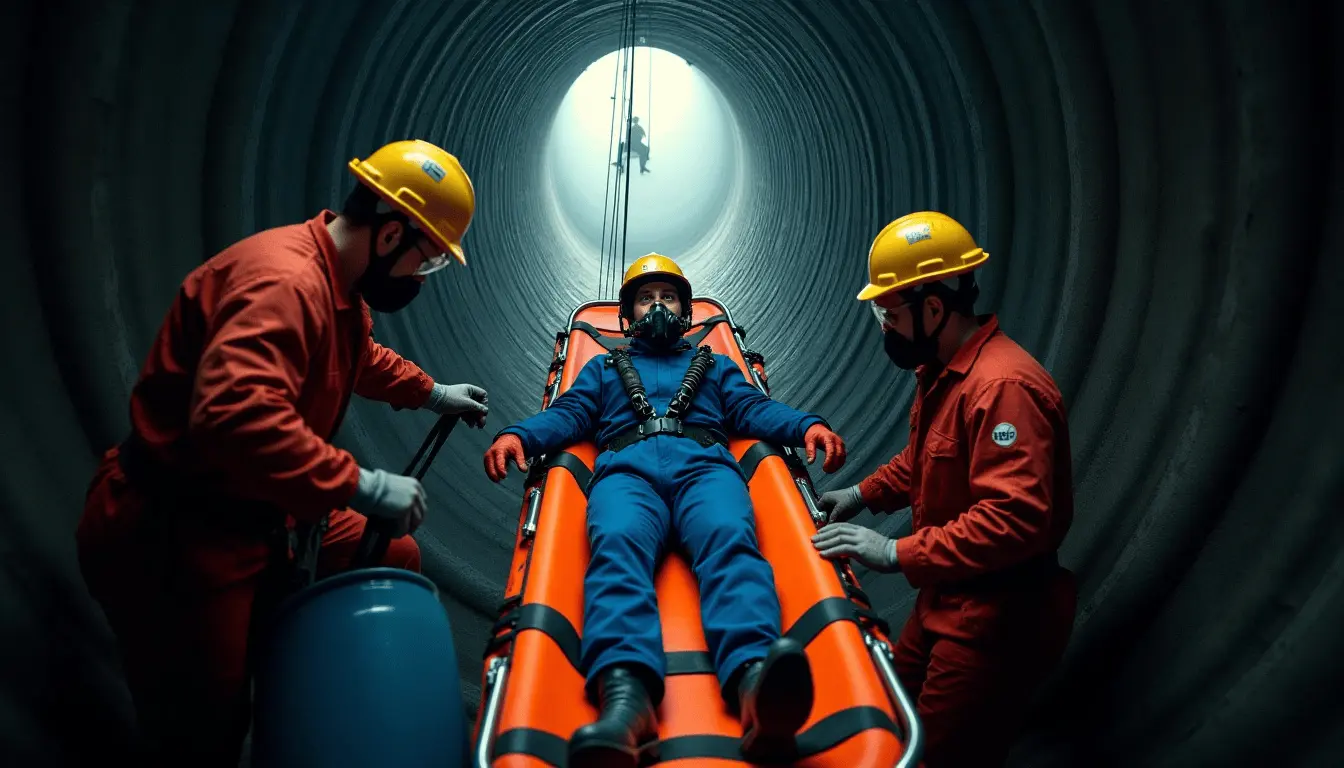
NIST Global's Confined Space Rescue Training is scenario-based and hands-on. In a controlled simulated IDLH environment, participants respond to a rescue alert, evaluate the emergency, determine the correct rescue method, utilise appropriate PPE and SCBA, enter the space (where required), perform a rescue on an unconscious victim using a SKED stretcher, extract the casualty, and deliver post-rescue first aid. This is rescue training, not rescue awareness.
The Three Categories of Confined Space Rescue — and When Each Applies
The correct rescue category must be determined within seconds of a rescue alert. Choosing the wrong method — or attempting a category you are not trained for — can kill the rescuer.
Non-entry retrieval is the safest and most preferred rescue method because no rescuer enters the hazardous atmosphere. The incapacitated victim is extracted by pulling the retrieval line connected to their full-body harness dorsal D-ring, using a mechanical advantage winch system — typically a rescue tripod positioned directly over the entry opening — to haul the victim vertically through the entry point. Non-entry retrieval is only possible when: the victim is wearing a properly fitted full-body harness with the retrieval line pre-connected and tensioned before incapacitation; the space geometry allows the body to travel from its location to the entry opening without obstruction; and the entry point is large enough to allow the victim's body to pass through in a controlled manner. This is why the retrieval line must be attached before entry, maintained under tension by the attendant throughout, and the space pre-assessed for extraction feasibility. If any of these conditions are not met, non-entry retrieval cannot proceed and entry rescue must be activated immediately.
- Confirm retrieval line is connected to victim's dorsal D-ring — do not enter to check
- Position rescue tripod directly over entry point — legs spread to maximum stability
- Attach retrieval line to winch — remove all slack before applying lifting force
- Apply steady, controlled winch force — avoid jerking which can cause harness failure or injury
- Maintain attendant communication throughout — call out status continuously
- If resistance is felt — stop; do not force; the victim may be snagged; escalate to entry rescue
- Once victim clears entry point — lower gently to ground; do not drop
- Initiate first aid immediately — asphyxiation management, CPR if required
Entry rescue is required when non-entry retrieval is not possible — because the victim is not harnessed, the retrieval line is not connected, the space geometry prevents extraction from outside, or the victim is trapped by physical obstruction. Entry rescue carries significant risk to rescuers because they are entering the same environment that incapacitated the victim. It must only be attempted by trained personnel with appropriate respiratory protection in place before crossing the entry threshold. The entry rescue team must: confirm atmospheric conditions via gas testing or assume IDLH and enter on SCBA; work as a minimum two-person buddy team — one enters, one is positioned at the entry point; locate the victim; attach a retrieval harness or casualty sling if not already fitted; package the victim in a SKED stretcher if required by the space geometry; and communicate status to the outside team throughout. Entry rescue is time-critical but must not be rushed into — a rescuer who enters without SCBA is not performing a rescue, they are creating a second casualty.
- Don SCBA — check air supply, seal test, low-pressure alarm — before crossing entry threshold
- Minimum two rescuers — one entry, one stationed at opening to manage retrieval line and communications
- Confirm communications working — radio check or hardwired intercom before entry
- Set time limit — agree maximum time inside based on SCBA air supply; exit before low-pressure alarm
- Locate victim — assess responsiveness, breathing, visible injuries, harness status
- Attach retrieval system — dorsal D-ring if harness fitted; casualty sling if not
- Package for extraction — SKED stretcher if victim cannot be extracted in vertical position
- Exit immediately on low-pressure alarm — do not delay for any reason
Emergency services rescue is required when the incident exceeds the capability of the site's own rescue team — when the victim is physically trapped and cannot be extracted by standard retrieval equipment, when multiple casualties are present simultaneously, when structural collapse or flooding has occurred inside the space, or when the entry geometry prevents safe access by site rescue teams. The decision to call emergency services must be made early — not as a last resort after site teams have exhausted their options and precious time. Emergency services should be called as soon as a rescue alert is activated, in parallel with the site team's initial assessment, so that specialist teams are en route while site rescuers attempt non-entry retrieval. Site rescue teams must not attempt rescue methods they are not trained and equipped for in the belief that "waiting for the fire brigade takes too long" — an untrained entry attempt that creates additional casualties makes the emergency services rescue more complex, more dangerous, and more likely to be fatal.
- Call immediately — not after site team has "tried everything"; call in parallel with initial response
- Victim physically trapped — structural obstruction, engulfment, mechanical entrapment
- Multiple casualties — site team capacity exceeded
- Space geometry prevents safe extraction — narrow, inverted, or complex access
- Site SCBA supply depleted or unavailable — do not enter without breathing apparatus
- Provide emergency services with: space location and type, number of casualties, last known atmosphere readings, access route, and site contact
- Do not attempt to hold the scene for site team if the delay would be fatal — call EMS and fire rescue
Every confined space rescue ends with a casualty who has been exposed to an atmosphere that incapacitated them — oxygen deficiency, toxic gas, or both. The first aid response must be initiated the moment the victim clears the entry point, and must be tailored to the specific exposure. For oxygen deficiency casualties: assess responsiveness; if unresponsive and not breathing, begin CPR immediately — 30 compressions to 2 rescue breaths; administer high-flow oxygen via non-rebreather mask as soon as available. For carbon monoxide (CO) casualties: ensure the casualty is in fresh air; administer high-flow oxygen; monitor for delayed deterioration — CO symptoms can worsen hours after removal. For hydrogen sulphide (H₂S) casualties: prioritise airway management and oxygen; CPR if cardiac arrest; H₂S can cause delayed pulmonary oedema — monitor breathing carefully post-rescue. For all casualties: do not provide first aid inside or adjacent to the confined space — the hazardous atmosphere may still be present at the entry point; maintain the first aid zone at a safe distance from the space.
- Move casualty away from entry point — to fresh air, away from any residual gas
- Assess responsiveness — call out, tap shoulders; if no response, begin primary survey
- Check airway and breathing — if no normal breathing, begin CPR immediately
- CPR — 30 chest compressions, 2 rescue breaths; continue until EMS arrives or casualty responds
- High-flow oxygen — administer via non-rebreather mask at 10–15 L/min as soon as available
- AED — apply as soon as available; asphyxiation-related cardiac arrest responds well to early defibrillation
- CO casualty — high-flow O₂ displaces CO from haemoglobin; maintain until EMS confirms
- Do not leave the casualty — maintain monitoring and documentation until EMS handover
Rescue Equipment — What Every CSR Team Member Must Be Able to Deploy
Equipment that has never been touched in training will not be deployed correctly in an emergency. Every piece of CSR kit must be practiced, not just described.
The rescue tripod is the primary piece of non-entry rescue equipment — a three-legged aluminium or steel frame positioned over the confined space entry opening, providing the mechanical anchor point for vertical victim retrieval. The tripod must be rated for the combined weight of the victim plus dynamic rescue loading; a standard rescue tripod is rated at approximately 250 kg static / 140 kg dynamic. The mechanical winch (typically 3:1 or 6:1 mechanical advantage) attaches to the apex of the tripod and connects to the victim's retrieval line. Correctly rigging a rescue tripod takes under 60 seconds for a trained team — it is a task that must be practiced until it is automatic, because the time between a rescue alert and the need to extract a victim may be as short as 2 minutes before irreversible brain damage begins. Tripod selection must account for the entry point type — a standard tripod works over a vertical manhole; a davit arm is required for horizontal or offset entries where a tripod cannot be positioned directly over the opening.
- Inspect legs for cracks, dents, or deformation — do not use damaged equipment
- Verify leg locking pins are secure and fully engaged at the correct height
- Check winch — load test, cable condition, ratchet function, and brake mechanism
- Inspect retrieval line — no cuts, fraying, kinks, or evidence of chemical degradation
- Verify safety factor markings are legible and within rated capacity for the operation
- Position legs at maximum spread — never use a tripod with partially opened legs
- Confirm the tripod apex is directly over the entry point — offset rigging reduces effective load capacity
SCBA is mandatory for any entry rescue where the atmosphere has not been verified safe — and in practice, if the atmosphere was safe, the victim would not have been incapacitated. SCBA provides a completely self-contained air supply from a pressurised cylinder worn by the rescuer, delivering breathing air independent of the surrounding atmosphere. A standard 6.8-litre SCBA cylinder at 300 bar provides approximately 30–45 minutes of air under normal breathing; this reduces significantly under physical exertion in a rescue scenario — a realistic working time inside the space on SCBA may be 15–20 minutes before the low-pressure alarm sounds. This time constraint determines the rescue plan: know the working time, set a maximum in-space time before entering, and exit before the alarm regardless of rescue progress. A rescuer who ignores the low-pressure alarm to complete a rescue will become a second casualty. The correct action on low-pressure alarm is immediate exit — the outside team continues with retrieval from outside while a fresh SCBA team re-enters if required.
- Pressure — check cylinder pressure gauge; minimum 90% (270 bar on 300 bar set)
- Air — open cylinder valve fully; breathe from the set to confirm positive pressure flow
- Seal — perform positive and negative pressure face mask seal test
- Signals — confirm low-pressure alarm sounds at correct threshold (approximately 55 bar)
- Don sequence — cylinder first, harness adjusted, mask donned last, seal test, valves open
- Communications check — radio or hardwired intercom working before crossing entry threshold
- Time limit — agree maximum in-space time with outside team before entry; exit before low-pressure alarm
The SKED stretcher is a flexible, rollable, semi-rigid plastic stretcher designed specifically for confined space victim packaging and extraction. Unlike a rigid ambulance stretcher, the SKED can be rolled up for entry into a confined space, deployed around a supine victim, and used to contain and protect the victim's body during extraction through narrow, awkward, or vertical egress points. The SKED is particularly important when the victim must be extracted horizontally through a manhole-type opening, through a narrow access hatch, or when the victim has sustained injuries that prevent safe handling without full body immobilisation. In a simulated rescue scenario, participants practice: unrolling the SKED inside a confined space with limited working room; positioning an unconscious victim onto the SKED without additional injury; attaching the SKED straps and retrieval attachment points; and co-ordinating the extraction through the entry point with the outside retrieval team. Casualty packaging in a confined space is physically demanding and disorienting — it must be practiced, not just demonstrated.
- Unroll SKED beside victim — deploy flat, straps accessible
- Log roll victim onto SKED — maintain spinal alignment; 2 rescuers minimum
- Position victim centrally — head toward extraction end, arms by sides inside SKED
- Close and secure all straps — starting from feet, working toward head
- Attach retrieval line to SKED head attachment point — confirm load-rated attachment
- Communicate to outside team — "Victim packaged, ready for extraction"
- Guide SKED toward entry point — rescuer maintains control of victim's position during extraction
Even in an entry rescue scenario, atmospheric assessment must occur before any rescuer crosses the entry threshold without SCBA — and must occur for every rescuer to determine whether SCBA is required. A pump-aspirated four-gas detector sampling from outside the entry point provides critical pre-entry atmospheric data in under 30 seconds — enough to determine whether the atmosphere is immediately dangerous to life and health (IDLH) or whether it is within limits where entry without SCBA may be possible. In a confined space rescue, the default assumption should always be that the atmosphere is IDLH — because if it were safe, the victim would not have been incapacitated. Personal gas monitors worn by entry rescuers provide continuous monitoring during the rescue, providing an additional warning if conditions deteriorate during the rescue operation. Personal monitors worn by entry rescuers must be set to alarm at action levels — not IDLH levels — so that the rescuer receives warning of deteriorating conditions with enough time to exit before the atmosphere becomes immediately dangerous.
- Default assumption in rescue is IDLH — use SCBA unless atmosphere is confirmed safe
- Sample from outside entry point before any non-SCBA entry — takes under 30 seconds
- All entry rescuers wear personal monitors — even when wearing SCBA
- Set rescue monitor alarms at action levels — not IDLH — for early warning during rescue
- Bump test and zero the monitor before the rescue team deploys — not during the emergency
- Record gas readings during rescue — this is evidence for incident investigation and legal proceedings
8-Step Confined Space Rescue Response Sequence
Every rescue team member must be able to execute this sequence from memory — because in a confined space emergency, there is no time to consult a procedure card.
Activate the Rescue Alert
Attendant activates emergency alarm, calls the rescue team, and contacts emergency services simultaneously. No delay. Both site rescue and EMS are called in parallel — not sequentially.
Prevent Additional Entry
Attendant prevents any unauthorised person from entering the space. The second-most common cause of multiple fatalities is an untrained colleague entering to help. The entry point must be controlled.
Atmospheric Assessment
Rescue team leader samples the atmosphere from outside the entry point using a pump-aspirated gas detector. Result determines rescue method — if IDLH or unknown, all rescue proceeds on SCBA.
Attempt Non-Entry Retrieval
If the victim is harnessed and retrieval line is connected, rig tripod and attempt non-entry retrieval immediately. This is the fastest and safest option — attempt first, escalate if resistance is felt.
Escalate to Entry Rescue if Required
If non-entry retrieval fails or is not possible, rescue team dons SCBA and enters as a minimum two-person buddy team. Outside team manages retrieval line, communications, and EMS contact.
Package Victim for Extraction
Inside rescuers attach retrieval harness or deploy SKED stretcher. Communicate victim status and packaging progress to outside team continuously. Exit before low-pressure alarm activates.
Extract & Initiate First Aid
Outside team coordinates extraction. First aid officer begins primary survey immediately as victim clears entry point — CPR if no breathing, high-flow O₂, casualty position, and EMS handover preparation.
Scene Preservation & Debrief
Preserve the scene — do not ventilate or disturb until investigators arrive. Document all actions, times, and gas readings. Conduct post-rescue debrief and incident report within 24 hours.
CSR Training Topics — What This Programme Covers
Structured to build rescue competency progressively — from rescue category selection through equipment operation, team roles, simulated rescue drills, and post-rescue first aid.
Confined Space Rescue Categories
Non-entry retrieval, entry rescue, and emergency services rescue — when each applies, the decision criteria, and the legal accountability that comes with choosing the wrong method under pressure.
Rescue Hazard Assessment
Identifying and evaluating atmospheric, physical, and environmental hazards during a rescue operation — including the hazards that incapacitated the original victim and the additional hazards created by the rescue itself.
Tripod, Winch & Retrieval System
Hands-on tripod rigging and mechanical winch operation — including davit arm alternatives, retrieval line management, victim weight assessment, and the specific failure modes that cause retrieval system incidents.
SCBA Operation in Rescue Conditions
SCBA donning sequence, air supply management, low-pressure alarm response, PASS checks, and the specific challenges of SCBA use in confined spaces — restricted movement, physical exertion, reduced air time, and communication limitations.
Victim Packaging & SKED Stretcher
SKED stretcher deployment in confined spaces, unconscious victim handling and log-roll technique, casualty sling attachment, co-ordinating extraction through awkward entry points, and maintaining spinal precautions during rescue.
Post-Rescue First Aid
CPR in post-confined space rescue conditions, high-flow oxygen administration, specific first aid protocols for oxygen deficiency, CO poisoning, and H₂S exposure — and casualty monitoring and EMS handover procedures.
What Participants Can Do After This Training
Competency-based outcomes — what every trained rescue team member should be able to perform independently under pressure, from the moment a rescue alert is activated.
Determine the Correct Rescue Method in Seconds
Evaluate an active confined space rescue scenario, determine whether non-entry retrieval, entry rescue, or emergency services escalation is appropriate, and initiate the correct response without hesitation.
Rig a Rescue Tripod & Operate the Winch
Set up a rescue tripod over a confined space entry point, attach the mechanical winch, connect a retrieval line, and perform a controlled victim extraction — in under two minutes, in the correct sequence, independently.
Don and Operate SCBA for Entry Rescue
Complete the full PASS pre-use check, don SCBA correctly, enter a confined space with simulated IDLH atmosphere, perform a rescue task, and respond correctly to a low-pressure alarm — exiting before air supply is critically depleted.
Package an Unconscious Victim for Extraction
Deploy a SKED stretcher inside a confined space with restricted working room, log-roll an unconscious victim onto the SKED, secure all attachment points, and coordinate extraction through the entry point with the outside team.
Deliver Correct Post-Rescue First Aid
Perform primary survey on an extracted confined space casualty, initiate CPR if required, administer high-flow oxygen, identify the specific exposure type (asphyxiation, CO, H₂S) and apply the correct first aid protocol through to EMS handover.
Execute a Full Rescue Drill as Team Leader or Member
Lead or participate in a complete simulated confined space rescue — from rescue alert activation through non-entry retrieval attempt, SCBA entry rescue, victim packaging, extraction, and post-rescue first aid — in a controlled simulated IDLH environment.
Why Employers Invest in Confined Space Rescue Training
A rescue team that has never practiced is not a rescue team. It is a group of people who will improvise in a crisis — and improvisation in a confined space emergency costs lives.
Saves Lives — Literally
The difference between a trained and untrained confined space rescue team is measured in minutes. Early, correct rescue execution is the primary determinant of whether an incapacitated worker survives neurologically intact or does not survive.
Prevents Rescuer Fatalities
Trained rescuers know when not to enter — breaking the instinct-driven rescuer fatality pattern that kills over 50% of confined space victims. Non-entry retrieval competency is the primary life-saving skill.
Equipment Deployed Correctly Under Pressure
Rescue equipment that has only been seen in a catalogue will be fumbled in an emergency. Hands-on practice under simulated rescue conditions builds the muscle memory required for correct deployment when seconds count.
Correct First Aid for Specific Exposures
Generic first aid training does not cover the specific protocols for CO poisoning, H₂S exposure, or oxygen deficiency casualties. CSR training delivers first aid tuned to the actual medical emergencies that confined space rescues produce.
Rescue Team Cohesion
Rescue is a team activity. Drill-based training builds the communication patterns, role clarity, and mutual trust that allow a rescue team to function under pressure — without the verbal chaos that untrained groups produce in crises.
Improved Emergency Response Culture
Organisations with trained, equipped, and regularly drilled rescue teams create a visible safety culture signal — that the organisation takes its duty of care seriously enough to prepare for the worst.
Factories Act 1948 Compliance
Factories Act 1948 and relevant State Factory Rules require that rescue arrangements are in place before any confined space entry begins. A trained, equipped, and available rescue team is the documented evidence of compliance with this requirement.
IS 15258 Rescue Requirement
IS 15258 (Indian Standard for confined space operations) specifies that a rescue plan must be documented, a rescue team must be identified and trained, and rescue equipment must be available before entry. CSR training certification satisfies the competency element.
Incident Investigation Defence
When a confined space incident results in a fatality, investigators examine rescue arrangements first. Training records, drill logs, and equipment inspection records demonstrate that the organisation met its duty of care. Their absence is evidence of negligence.
Contractual Compliance
Major EPC contractors and multinational operators increasingly specify confined space rescue team certification as a contractual requirement. CSR-trained teams enable access to safety-critical contracts and project sites.
Reduced Liability & Insurance
Documented rescue training and drill records are material factors in industrial liability claims, workers' compensation cases, and insurance assessments. Demonstrated preparedness reduces the organisation's exposure in every legal forum.
DGFASLI Inspection Readiness
DGFASLI inspectors of confined space operations examine rescue arrangements as a primary compliance element. Training certificates, drill records, and equipment inspection logs provide the documentary evidence required.
Faster Emergency Response Time
Trained teams respond faster because there is no decision-making delay at the start of the rescue — the sequence is drilled, the equipment is familiar, and the roles are assigned. Response time reduction directly improves casualty survival outcomes.
Reduced Dependence on External Rescue
Organisations with in-house rescue capability do not have to wait for fire services or external contractors to arrive. For critical remote sites, offshore locations, or facilities in areas with limited emergency services response capacity, this capability is not optional.
Equipment Readiness Assurance
Rescue teams that regularly practice also regularly inspect and test their equipment. Trained teams identify degraded equipment before an emergency — not during one.
Sector-Specific Customisation
NIST Global tailors CSR training to the specific confined space types, atmospheric hazards, and entry geometries of your facility — so rescue drills are conducted in scenarios that directly reflect your operational reality.
Business Continuity Protection
A confined space fatality shuts down operations, triggers regulatory investigations, generates media attention, and destroys workforce morale. A rescue team that performs correctly converts a potential fatality into a successful rescue and a manageable incident.
Measurable Drill Performance
NIST Global's scenario-based training includes timed drill performance — providing measurable rescue response time benchmarks, team role execution scores, and identified improvement areas that organisations can track and improve over successive training cycles.
Rescue Cannot Be Learned
from a Slide Deck Alone
Every NIST Global CSR programme is scenario-driven. Participants respond to live rescue alerts, rig equipment, don SCBA, package victims, and deliver first aid — not watch demonstrations.
NIST Global by the Numbers
Our Impact Speaks for Itself
Measurable outcomes across 500+ organisations — because a world-class safety culture is built on data, not assumptions.
Who Needs Confined Space Rescue Training?
Anyone designated as part of an on-site confined space rescue capability — from ERT members to attendants who may be the first to respond to an incapacitation event.
Emergency Response Team (ERT) Members
The designated first responders to confined space emergencies at industrial facilities — required to be trained, equipped, and drilled before a confined space entry programme can be considered adequately protected.
Confined Space Attendants
Attendants are the first on scene when an entrant is incapacitated. Training in non-entry retrieval and the correct emergency response sequence is essential — they must act immediately and correctly without entering the space.
Entry Supervisors & HSE Officers
Responsible for verifying rescue arrangements are in place before every entry and for directing the initial response to a rescue incident — must understand rescue categories, equipment, and escalation criteria.
Maintenance & Operations Supervisors
Supervisors of teams that regularly work in or around confined spaces must understand rescue capability requirements and be able to verify that rescue arrangements for their operations are adequate.
Site First Aiders
Site first aiders who may respond to a confined space casualty need specific training in the first aid protocols for asphyxiation, oxygen deficiency, CO poisoning, and H₂S exposure — not covered in standard first aid courses.
Oil, Gas & Petrochemical Personnel
Facilities with permit-required confined spaces in high-hazard atmospheric environments require formally trained and regularly drilled rescue teams — not merely rescue arrangements on paper.
CSR Training Delivered Across Every High-Risk Sector
NIST Global customises rescue scenarios to reflect the specific confined space types, entry geometries, and atmospheric hazards of your industry and facility.
Oil & Gas
Petrochemicals
Manufacturing
Water & Wastewater
Metro & Tunnelling
Power & Utilities
Construction
Marine & Offshore
Build Complete Confined Space Safety Competency
CSR training is the emergency capability layer. The full confined space safety system requires all three programmes working together.
Questions About Confined Space Rescue Training
Answers written by NIST Global's confined space safety specialists — structured for SEO, GEO search, and generative AI answer extraction.
Further Reading on Confined Space Rescue & Emergency Response
Practical knowledge from NIST Global's safety specialists on rescue procedures, equipment, and the patterns behind confined space fatalities.
What Is a Confined Space? Types and Examples
A comprehensive guide to confined space classification, permit-required vs. non-permit spaces, and the hazard types that create the need for trained rescue capability.
Read article →The Importance of Confined Space Entry Training
Why confined space safety requires trained workers at every level — and how CSE and CSR training work together to prevent incidents and protect those who respond when prevention fails.
Read article →The Rescuer Fatality Pattern — Why Good Intentions Kill in Confined Spaces
An analysis of why over 50% of confined space deaths are rescuers, what makes the instinct to enter so difficult to override, and what training must accomplish to break this pattern reliably.
Read article →Build a Rescue Team That Can Act Before Ambulances Arrive
Tell us about your operations and we'll design a fully customised Confined Space Rescue Training programme — the right rescue scenarios, equipment types, space geometries, and atmospheric hazards for your specific facility. Delivered on-site with live simulated rescue drills across India.
- ✓Non-entry retrieval and entry rescue — both categories, hands-on
- ✓Tripod and winch rigging practice at your actual entry points
- ✓SCBA donning, air management, and low-pressure alarm response
- ✓SKED stretcher deployment and victim packaging drills
- ✓Post-rescue first aid — asphyxiation, CO, H₂S protocols
- ✓Factories Act 1948, IS 15258, and DGFASLI compliant
Prefer to call directly?
+91 87544 65588