

Authorised Gas Tester (AGT) Training in India — Certify Testers. Clear Every Entry.
Hydrogen sulphide kills at 300 ppm — and shuts off your ability to smell it at 100 ppm. Oxygen deficiency causes unconsciousness before any warning sensation. Carbon monoxide is invisible, odourless, and lethal. NIST Global's Authorised Gas Tester Training gives your teams the technical knowledge to detect every invisible threat, calibrate and operate gas detectors correctly, integrate with Permit to Work systems, and respond decisively to any gas emergency — before the atmosphere decides for them.
AGT training built for your site's gas hazard profile and industry requirements
Four Reasons Atmospheric Hazards Kill Without Warning
Gas hazards do not announce themselves. They have no colour, no smell at lethal concentrations, and no grace period between exposure and incapacitation.
60%+ of Confined Space Deaths Are Rescuers
Would-be rescuers who enter without atmospheric testing to help a fallen colleague account for more than 60% of confined space fatalities. No testing = no rescue attempt.
H2S Destroys Your Ability to Smell It
Hydrogen sulphide desensitises the olfactory nerve above 100 ppm, workers stop smelling the gas just as it becomes lethal at 300 ppm. You cannot smell your way to safety.
Oxygen Deficiency Gives No Warning
An atmosphere at 16% oxygen looks, smells, and feels normal until you fall unconscious. There is no physical sensation of oxygen deficiency until it is too late to escape.
Legal Liability Without Certified Testers
Factories Act 1948, Petroleum Rules 2002, and OISD standards require competent gas testing. An uncertified tester means the permit is invalid and every person on site is at legal risk.
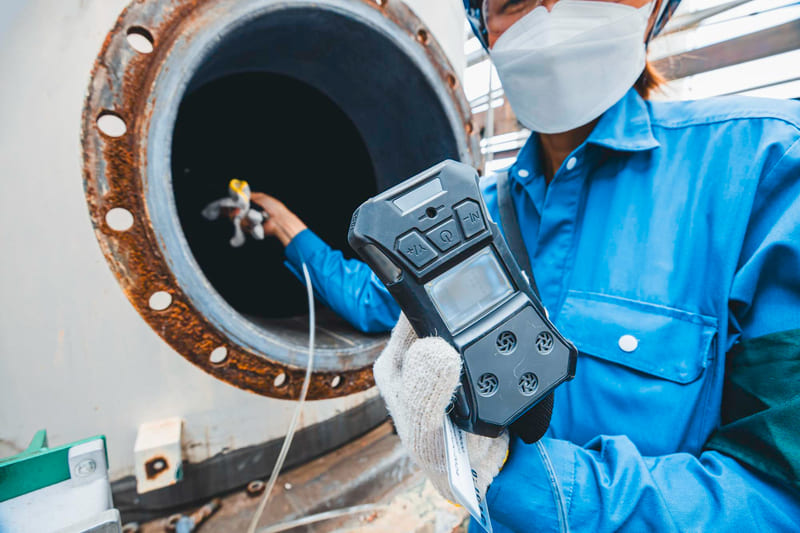
What Is an Authorised Gas Tester — and Why Does the Role Carry Legal Weight?
An Authorised Gas Tester (AGT) is a trained, competent individual certified to assess atmospheric conditions in confined spaces, tanks, pits, manholes, and high-risk work areas before and during entry or hot work operations. Using calibrated multi-gas detectors, the AGT measures oxygen levels, toxic gas concentrations, and the percentage Lower Explosive Limit (% LEL) of flammable atmospheres — and issues or withholds the gas clearance that is the legal prerequisite for the Permit to Work.
Unlike most safety roles, the AGT carries direct personal accountability. In the event of a gas-related fatality, regulatory investigations will examine whether a certified AGT conducted testing, whether testing was performed correctly and at the right intervals, whether the detector was calibrated and bump-tested, and whether the gas clearance was accurately documented. An untrained or improperly certified gas tester is not just a safety liability — it is a criminal liability.
NIST Global's AGT training goes beyond awareness. Participants leave with the practical ability to conduct pre-entry testing, perform bump tests and span calibrations, interpret multi-parameter gas readings, make entry/no-entry decisions, and complete gas clearance documentation to the standard required by Factories Act 1948, OISD guidelines, and leading industry PTW frameworks.
Four Atmospheric Hazards Every AGT Must Detect
Every multi-gas detector test covers four parameters. Understanding what each one means — and why a reading can be wrong — is the difference between a competent AGT and a box-ticking exercise.
Normal atmospheric oxygen is 20.9%. Below 19.5%, the atmosphere is oxygen-deficient — causing impaired judgement, rapid fatigue, unconsciousness, and death. Below 16%, loss of consciousness can occur without any physical warning. Above 23.5%, oxygen-enriched atmospheres dramatically accelerate the flammability and combustion of materials, turning a simple spark into a fireball. Causes of deficiency include biological decomposition of organic matter, displacement by heavier gases (CO₂, H₂S), and incomplete combustion from engines running in enclosed spaces. The AGT must test for oxygen at multiple levels in the space — at the top, middle, and bottom — because oxygen displacement is not always uniform.
- 20.9% — Normal atmospheric oxygen; baseline reading for a calibrated sensor
- 19.5% — Entry not permitted below this level without supplied-air breathing apparatus
- 16% — Rapid loss of coordination and consciousness; immediate evacuation
- 10% — Fatal; unconsciousness in seconds, death within minutes
- 23.5% — Oxygen-enriched; fire and explosion risk dramatically elevated
- Sensor note — O₂ sensors are electrochemical cells; they consume O₂ and have a finite life; check manufacturer's expiry date before every shift
- Stratification — CO₂ and H₂S (heavier than air) displace O₂ from the bottom up; always sample low in the space
Hydrogen sulphide smells of rotten eggs — but only at low concentrations. Above 100 ppm, olfactory fatigue causes workers to lose the ability to smell it, creating a false sense of safety at the exact moment the hazard becomes lethal. At 300 ppm, pulmonary oedema (fluid in the lungs) develops rapidly. At 500–700 ppm, rapid unconsciousness occurs — often called the "knockdown" — followed by death within minutes. H₂S is heavier than air (density 1.19 relative to air), meaning it accumulates at the lowest points of confined spaces. Sources include sewage systems, wastewater treatment, petrochemical processes, paper mills, tanneries, and decomposing organic matter in any enclosed space.
- 1 ppm TWA — Indian workplace time-weighted average limit (8-hour shift)
- 5 ppm STEL — Short-term exposure limit (15-minute average); cease non-essential work
- 10 ppm — Alarm 1 setpoint; increased monitoring, review ventilation
- 20 ppm — Alarm 2 setpoint; all personnel must don breathing apparatus or evacuate
- 50 ppm IDLH — Immediately Dangerous to Life and Health; immediate evacuation
- 100 ppm — Olfactory nerve paralysis; worker cannot smell the gas; cannot self-rescue
- Sensor note — H₂S can poison catalytic bead LEL sensors; multi-gas detectors must have dedicated electrochemical H₂S cells
Carbon monoxide has no colour, no smell, and no taste at any concentration. It binds to haemoglobin approximately 200 times more readily than oxygen, forming carboxyhaemoglobin that cannot carry oxygen to tissues. Symptoms — headache, dizziness, nausea — are often mistaken for dehydration or heat exhaustion, and may not appear until a dangerous dose has already accumulated. CO is slightly lighter than air but mixes readily throughout a space; it does not settle or stratify predictably. Primary sources in industrial confined space work include diesel generators and plant running near space openings, incomplete combustion in hot work, and biomass decomposition. The AGT must test for CO before any hot work permit is issued regardless of whether CO sources are apparent.
- 25 ppm TWA — Indian workplace limit (8-hour shift); long-term safe working level
- 35 ppm — US NIOSH recommended ceiling; increased monitoring required
- 50 ppm — Alarm 1; increased ventilation, reduce exposure duration
- 100 ppm — Alarm 2; immediately evacuate non-essential personnel
- 200 ppm — Headache, dizziness within 2–3 hours; no one should be present
- 1,200 ppm IDLH — Immediate threat to life; emergency evacuation
- Sensor note — CO sensors can cross-react with H₂ (hydrogen) — always verify sensor type and cross-sensitivity with manufacturer
The Lower Explosive Limit (LEL) is the minimum concentration of a flammable gas in air below which it cannot ignite. Measuring % LEL tells the AGT how close the atmosphere is to the ignition threshold — 100% LEL means the gas is at exactly its LEL concentration (e.g., methane at 5% by volume). The detector reads this as a ratio, allowing consistent alarm setpoints regardless of which gas is present. The critical technical point: catalytic bead (pellistor) LEL sensors require oxygen to function and give falsely low readings in oxygen-deficient atmospheres — a detector reading 0% LEL in a confined space is not necessarily safe if oxygen is also depleted. The AGT must always check both O₂ and % LEL and understand the interaction.
- 0–10% LEL — Safe zone for entry (with all other parameters within limits)
- 10% LEL — Entry alarm; stop work, investigate source, increase ventilation
- 25% LEL — Evacuation threshold; all personnel must leave the space immediately
- 100% LEL — The gas is at its exact lower explosive limit; any ignition source is catastrophic
- Common LEL values: Methane (CH₄) 5% v/v, Hydrogen (H₂) 4% v/v, Petrol vapour ~1.4% v/v
- Critical note — In O₂-deficient atmospheres, pellistor sensors give falsely low or zero LEL readings; use PID or infrared sensors in such environments
- Hot work rule — No hot work may proceed unless LEL is confirmed at 0% by a certified AGT immediately before work begins
Gas Detector Types — What Every AGT Must Understand
A reading is only as reliable as the sensor technology behind it. AGTs who don't understand their equipment's limitations put every person in the space at risk.
The four-gas portable detector is the standard AGT instrument — simultaneously measuring O₂, % LEL (combustible gases), CO, and H₂S in a single handheld unit. For most confined space entry, hot work, and tank cleaning operations, the four-gas detector covers the critical atmospheric hazards. The AGT must be able to perform a bump test, read and interpret all four channels simultaneously, respond to multi-alarm events (where more than one gas is simultaneously out of range), and complete calibration documentation. Personal clip-on detectors worn by workers provide continuous monitoring once inside; they complement but do not replace the AGT's pre-entry testing with a pump-aspirated sampling probe.
- Pre-use bump test — expose all sensor heads to known test gas and verify alarm activation
- Span calibration — quarterly or per manufacturer schedule using certified test gas mixture
- Sampling sequence — O₂ first, then % LEL, then toxic gases; understand why order matters
- Pump-aspirated testing — use flexible probe to sample at multiple depths before any entry
- Alarm response — understand action levels vs. evacuation levels for each channel
- Sensor cross-sensitivity — know which gases interfere with which sensors on your specific instrument
- Battery check — verify full charge; low battery causes inaccurate sensor readings
The catalytic bead sensor (pellistor) is the most common technology for measuring flammable gas concentrations (% LEL). It works by oxidising (burning) the target gas on a heated catalyst bead and measuring the resulting temperature change. This technology has a critical limitation that every AGT must understand: it requires oxygen to function. In an oxygen-deficient atmosphere (below approximately 10% O₂), the pellistor sensor cannot sustain the catalytic reaction and will give a falsely low or zero reading — indicating no flammable gas when the space may, in fact, be dangerously close to the UEL. This is called the "oxygen-inhibition failure mode" and has caused multiple fatalities where workers trusted a 0% LEL reading without checking O₂ first.
- Requires O₂ to function — always verify O₂ reading before interpreting % LEL
- Sensor poisons — silicones, lead compounds, sulphur gases (H₂S) degrade pellistor sensors over time
- Reading drift — sensors may drift low after prolonged H₂S exposure; check calibration history
- High-concentration suppression — at concentrations above 100% LEL, readings may drop back toward zero; this is not a safe reading
- Alternative required — in O₂-deficient environments, use infrared (IR) sensors for LEL measurement instead of pellistors
Electrochemical cells are the technology behind O₂, CO, H₂S, SO₂, NH₃, and most other toxic gas sensors in portable detectors. They work by generating an electrical current proportional to the target gas concentration through an oxidation/reduction reaction at the sensor electrode. Electrochemical cells are highly specific to their target gas (high selectivity), have a fast response time, are accurate at very low concentrations (ppm-level sensitivity), and do not require oxygen to function — making them the correct sensor choice for toxic gas detection in oxygen-deficient environments. However, they have a finite lifespan (typically 1–3 years), degrade in extreme temperatures, and can exhibit cross-sensitivity to other gases depending on the electrode chemistry.
- Sensor lifespan — electrochemical cells have a defined expiry date; check before use
- Cross-sensitivity — CO sensors can respond to H₂ (hydrogen); verify instrument-specific cross-sensitivity table
- Temperature effects — accuracy degrades at extreme temperatures; keep instruments within operating range
- Humidity effects — very high or very low humidity affects electrochemical sensor response
- Zero drift — sensors may drift in baseline reading; fresh-air zero the instrument in clean air before entering any space
The Photo-Ionisation Detector (PID) uses ultraviolet light to ionise gas molecules, generating a measurable electrical current. PIDs are the instrument of choice for detecting volatile organic compounds (VOCs) — solvents, fuel vapours, benzene, toluene, and similar substances — at very low concentrations (ppb-level sensitivity) where pellistor sensors cannot reliably detect below their threshold. PIDs are particularly relevant in tank cleaning, painting, chemical storage, and petrochemical maintenance operations. A critical limitation: PIDs cannot detect methane or simple alkanes (the primary components of natural gas), as these require photons of higher energy than standard UV lamps provide. PIDs are also expensive, require a clean UV lamp, and need regular maintenance to remain accurate.
- Cannot detect methane — PID is not a substitute for LEL measurement for natural gas applications
- UV lamp fouling — condensation or dust on the UV lamp gives falsely low readings; inspect and clean regularly
- Correction factors — PID response is calibrated for isobutylene; apply substance-specific correction factors for target VOCs
- Used with pellistors — in VOC-containing environments, use PID alongside pellistor detector for complete coverage
- Humidity sensitivity — high relative humidity reduces UV transmission; account for this in humid confined spaces
The 8-Step AGT Pre-Entry Gas Testing Procedure
Every AGT clearance follows a defined sequence. Skipping or reversing any step compromises the integrity of the clearance and can result in a fatality.
Instrument Pre-Use Check
Verify detector is in calibration, battery is fully charged, and sensors are within expiry. Perform bump test in fresh air outside the space. Document results.
Fresh Air Zero
Zero the instrument in clean, uncontaminated air at least 10 metres from the work area. Never zero inside or near the space. Verify all channels read baseline values.
External Visual Survey
Identify all entry and egress points, adjacent pipes, drains, and potential gas migration pathways before approaching the space. Check for signs of previous contamination.
Remote Pre-Purge Sampling
Using the pump-aspirated probe, sample the space atmosphere through the entry point before any ventilation is started. Record baseline gas levels — this establishes the pre-ventilation hazard profile.
Ventilation & Re-Test Sequence
Start forced ventilation. After each ventilation period, re-test at top, middle, and bottom of the space — gases stratify by density and ventilation may clear one zone while leaving another hazardous.
Confirm All Parameters Safe
All four parameters (O₂, % LEL, CO, H₂S — and any site-specific gases) must be within safe limits simultaneously before issuing clearance. A safe O₂ reading alone is insufficient.
Issue Gas Clearance Certificate
Complete the gas clearance section of the Permit to Work with all readings, time, instrument serial number, calibration date, and AGT signature. This is a legal document.
Continuous Monitoring During Work
Deploy personal gas monitors on all workers inside the space. Re-test at defined intervals, after any work interruption, and immediately if any alarm activates or if process conditions change.
AGT Training Topics — What This Programme Covers
Structured to build competency progressively — from hazard understanding to hands-on equipment operation to emergency response decision-making.
Atmospheric Hazard Science
Gas behaviour, density vs. air, dispersion patterns, stratification in confined spaces, flammability limits (LEL/UEL), toxicity thresholds (TLV, STEL, IDLH), and why H₂S is uniquely deceptive.
Gas Detector Operation & Calibration
Hands-on operation of multi-gas detectors — bump testing, span calibration, fresh-air zeroing, probe sampling technique, sensor cross-sensitivities, and the pellistor failure mode in O₂-deficient atmospheres.
Pre-Entry Testing Sequence
The complete pre-entry gas testing procedure — instrument checks, remote sampling, stratification testing at multiple levels, ventilation purge testing, and issuing the gas clearance certificate on a Permit to Work.
Permit to Work Integration
How the AGT role interfaces with the PTW system — gas clearance documentation, what happens when readings exceed action levels, permit suspension, and the AGT's authority and accountability on the permit.
Legal & Regulatory Framework
Factories Act 1948 and relevant rules, OISD standards for oil & gas facilities, Petroleum Rules 2002, IS 15258 (confined space safety), and industry-specific requirements for gas testing competency.
Gas Emergency Response
Non-entry emergency rescue protocols, evacuation procedures, first aid for toxic gas exposure and asphyxiation, why rescuers must not enter without atmospheric clearance, and emergency communication drills.
What Participants Can Do After This Training
Competency-based outcomes — what every certified AGT should be able to perform independently after completing NIST Global's programme.
Assess Any Confined Space Atmosphere
Conduct a complete pre-entry atmospheric assessment — selecting sample points, testing at multiple depths, and interpreting all four gas parameters simultaneously to make a scientifically sound entry/no-entry decision.
Calibrate and Operate Multi-Gas Detectors
Perform bump tests, fresh-air zeros, span calibrations, and know when to retire a sensor — including identifying the pellistor failure mode, sensor cross-sensitivities, and calibration documentation requirements.
Issue & Withdraw Gas Clearance on PTW
Complete gas clearance documentation on a Permit to Work, including all required readings, times, instrument references, and personal certification details — and withdraw clearance when conditions change.
Identify Gas Sources & Predict Stratification
Predict how specific gases (heavier or lighter than air) will behave in a confined space, identify likely gas sources based on the space's history and contents, and select appropriate sampling points to find stratified hazards.
Respond Correctly to a Gas Emergency
Execute non-entry emergency rescue protocols, direct evacuation, provide first aid guidance for gas exposure and asphyxiation victims, and prevent the rescuer-becomes-victim fatality pattern that causes 60%+ of confined space deaths.
Demonstrate Legal & Regulatory Competency
Explain the AGT's legal accountability under Factories Act 1948, OISD standards, and relevant rules — and apply this to gas clearance documentation in a way that withstands regulatory scrutiny and incident investigation.
Why Employers Invest in AGT Training
The return on AGT training is not measured in savings — it is measured in lives, permits, and the freedom to operate.
Precise Hazard Detection
Certified AGTs detect flammable, toxic, and oxygen-deficient atmospheres before workers enter — replacing guesswork with calibrated, documented evidence.
Prevents Rescuer Fatalities
Trained AGTs enforce non-entry emergency protocols — stopping the would-be rescuer from becoming the second fatality, which accounts for over 60% of confined space deaths.
Explosion Prevention
Continuous % LEL monitoring and correct alarm setpoints prevent the ignition of flammable atmospheres during hot work — the leading cause of refinery and petrochemical explosions.
Asphyxiation Prevention
Oxygen monitoring with correctly calibrated sensors and multi-level sampling catches stratified oxygen-deficient zones that visual inspection and single-point testing miss entirely.
Equipment Reliability
AGTs trained in bump testing and calibration procedures ensure gas detectors are operationally ready — preventing the leading cause of "false safe" readings: an uncalibrated or degraded sensor.
Proactive Safety Culture
Certified AGTs become on-site gas safety champions — raising atmospheric hazard awareness, challenging inadequate testing, and embedding gas safety into daily high-risk operations.
Factories Act Compliance
Demonstrates the competent person requirement for atmospheric testing under Factories Act 1948 and relevant State Factory Rules — a documented defence in regulatory inspection and incident investigation.
OISD Standard Compliance
Meets the Authorised Gas Tester certification requirements specified in OISD (Oil Industry Safety Directorate) standards for petroleum storage, refinery, and pipeline operations across India.
Valid Permit to Work Documentation
A PTW gas clearance signed by a certified AGT is legally defensible documentation. An uncertified tester invalidates the permit — exposing the permit issuer, contractor, and client to criminal liability.
Client & Contract Requirements
Major EPC contractors, oil & gas operators, and infrastructure clients specify AGT certification as a contractual requirement. Certified testers enable bidding and working on high-value, safety-critical contracts.
Incident Investigation Readiness
Training records, bump test logs, calibration certificates, and gas clearance documentation are the first items seized in a post-incident investigation. AGT training creates the paper trail that demonstrates due diligence.
DGFASLI & Inspector Compliance
DGFASLI (Directorate General Factory Advice Service & Labour Institutes) inspections of confined space operations check for competent gas testing procedures. Certification provides documented evidence of compliance.
Faster Permit Clearance
Trained in-house AGTs complete gas testing and issue clearance faster than calling for external testers — reducing permit processing time and getting workers into the space productively.
Reduced Third-Party Testing Costs
Building an in-house AGT capability eliminates the cost and scheduling delays of contracted gas testing for routine confined space, hot work, and maintenance operations.
Better Decision-Making Under Pressure
AGTs who understand gas behaviour make faster, more confident entry/no-entry decisions — reducing the "let's just go in and check" mentality that kills workers every year.
Equipment Longevity
Properly trained users bump test, calibrate, store, and maintain gas detectors correctly — extending sensor life, reducing false alarms, and avoiding the costly replacement of prematurely degraded instruments.
Sector-Specific Competency
NIST Global tailors AGT training to your industry — oil & gas, petrochemical, water treatment, tunnelling, construction, or manufacturing — so the scenarios, gases, and procedures are directly relevant to your operations.
Measurable Safety Performance Improvement
Organisations that implement certified in-house AGT programmes consistently report reductions in confined space near-misses, improved permit completion quality, and measurably shorter entry preparation times.
How NIST Global Delivers AGT Training That Sticks
Classroom theory without instrument handling doesn't create competent gas testers. Every NIST Global AGT programme combines learning formats to build both knowledge and practical skill.
NIST Global by the Numbers
Our Impact Speaks for Itself
Measurable outcomes across 500+ organisations — because a world-class safety culture is built on data, not assumptions.
Who Needs AGT Certification?
Anyone involved in authorising, conducting, or supervising atmospheric testing in confined spaces or high-risk work areas.
Permit Issuers & Receivers
Responsible for issuing and accepting confined space and hot work permits — must understand gas clearance requirements to issue valid permits.
Maintenance & Utility Technicians
Enter tanks, pits, manholes, and process vessels for inspection, cleaning, and maintenance — the primary cohort who performs and relies on gas testing.
HSE Officers & Supervisors
Responsible for verifying that gas testing is performed correctly, equipment is maintained, and PTW documentation meets regulatory standards.
Emergency Response & Rescue Personnel
Must understand atmospheric hazards, gas testing limitations, and non-entry rescue protocols to avoid becoming the second casualty in a confined space emergency.
Construction & Civil Contractors
Working in manholes, excavations, culverts, underground structures — all potentially confined spaces where atmospheric hazards can accumulate from adjacent processes or decomposing organics.
Oil, Gas & Petrochemical Operators
Working in tank farms, refineries, pipelines, and process plants — facilities where OISD certification of gas testers is a legal requirement, not an option.
AGT Training Delivered Across Every High-Risk Sector
NIST Global customises scenarios, gases, and regulatory references to match your specific industry's gas hazard profile.
Oil & Gas
Petrochemicals
Manufacturing
Water & Wastewater
Construction
Power & Utilities
Tunnelling & Metro
Pharmaceuticals
Build Complete Confined Space Competency
AGT certification is one part of a complete confined space safety programme. For full protection, organisations also deploy these complementary programmes.
Questions About AGT Training & Certification
Get an AGT Programme Built for Your Site's Gas Hazard Profile
Tell us about your operations and we'll design a fully customised Authorised Gas Tester Training programme — the right gases, the right detector types, the right regulatory framework, and the right practical scenarios for your specific industry and site. Delivered on-site or virtually across India.
- ✓All four atmospheric parameters — O₂, % LEL, CO, H₂S and site-specific gases
- ✓Hands-on multi-gas detector calibration and bump testing practice
- ✓Pre-entry gas testing procedure and stratification sampling
- ✓PTW integration — gas clearance documentation and certification
- ✓Factories Act 1948, OISD standards and Petroleum Rules 2002 compliant
- ✓English, Tamil, Hindi, and regional languages
Prefer to call directly?
+91 87544 65588