

Confined Space Entry Training in India — Train Every Role, Control Every Entry
Over 50% of confined space fatalities are would-be rescuers — people who entered without testing to help a fallen colleague, and died from the same invisible atmosphere. NIST Global's Confined Space Entry Training equips entrants, attendants, and supervisors to identify every hazard, test and control the atmosphere, operate within the permit system, and respond to emergencies without creating new casualties. Delivered on-site across India to offshore, metro rail, steel, petrochemical, and construction operations.
CSE training built for your specific confined space types, industries and regulatory requirements
Four Reasons Confined Space Entry
Kills Without Warning
50%+ of Deaths Are Would-Be Rescuers
More than half of confined space fatalities are people who entered to help a fallen colleague — without testing the atmosphere first. The same invisible hazard kills them instantly.
Hazardous Atmospheres Are Invisible
Oxygen-deficient, toxic, and flammable atmospheres have no visible warning. A space can look, smell, and feel perfectly normal at concentrations that cause unconsciousness within seconds.
Limited Egress Traps Incapacitated Workers
Confined spaces are designed for processes, not people. A worker who loses consciousness inside cannot self-rescue — and the awkward geometry prevents bystanders from extracting them safely.
Untrained Entry Voids Legal Protection
Factories Act 1948, IS 15258, and DGFASLI guidelines require competent persons for confined space operations. Untrained workers and unsupervised entry exposes every supervisor and employer to criminal liability.
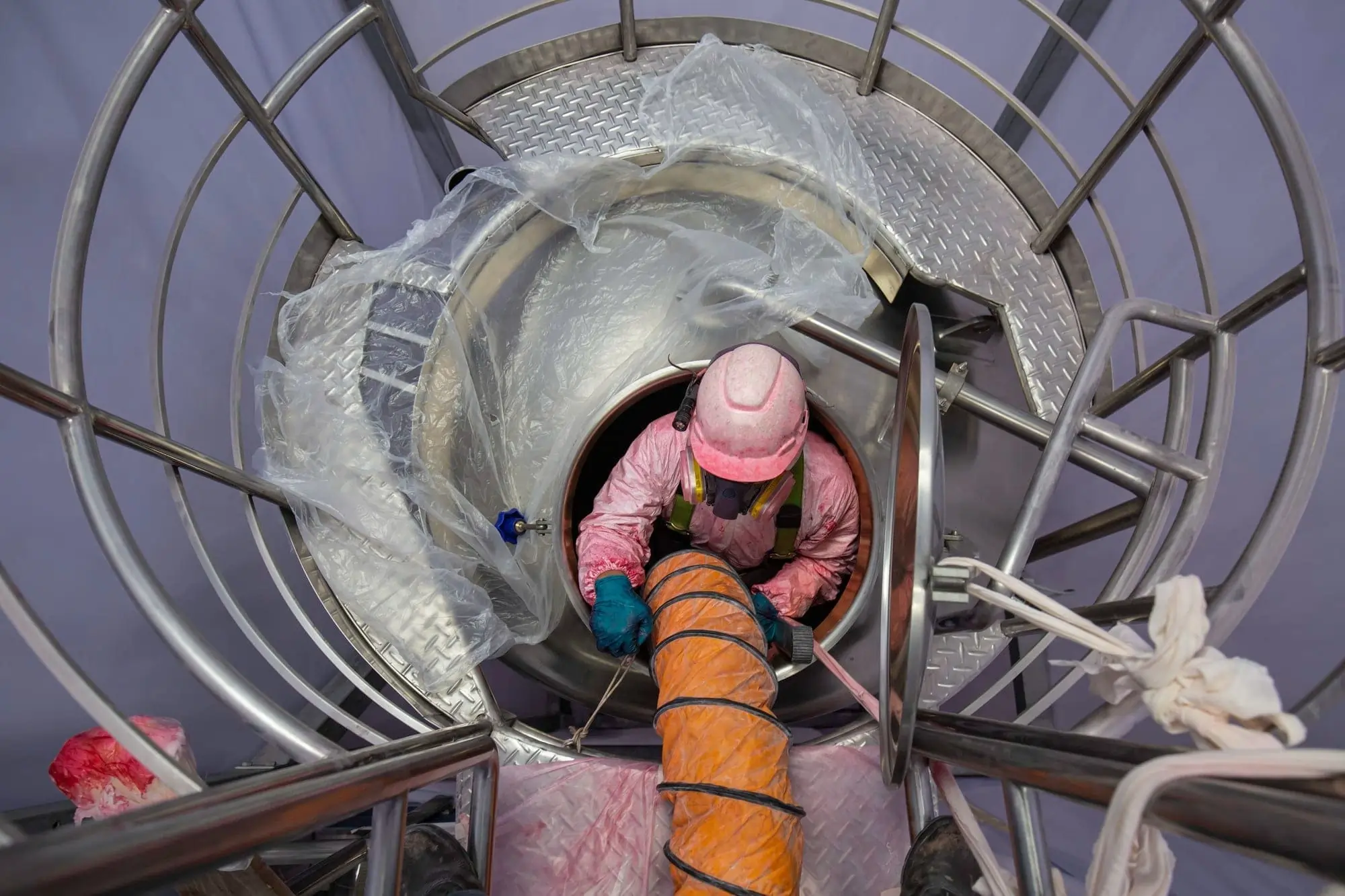
What Is Confined Space Entry Training — and Why Is Every Role Critical?
A confined space is any enclosed or partially enclosed area that is large enough for a worker to enter, has limited or restricted means of entry or exit, and is not designed for continuous human occupancy. Tanks, silos, manholes, tunnels, pipelines, sewers, pits, and storage vessels are all confined spaces — and each one has the potential to contain an atmosphere that kills before a worker can react.
NIST Global's Confined Space Entry Training is a comprehensive, site-specific programme that goes far beyond regulatory box-ticking. Participants understand the science behind why confined spaces are dangerous — how toxic gases accumulate and stratify, how oxygen is displaced, how engulfment and energy release hazards develop — and are trained in the practical skills to control every one of those hazards before a single entrant steps across the threshold.
Critically, the programme trains all three roles in the confined space entry system together: entrants understand their self-rescue responsibilities; attendants learn that their position outside the space is the single most important life-safety role in the operation and that they must never enter; and supervisors learn how to verify pre-entry conditions, issue and cancel permits, and exercise their authority to abort an entry regardless of production pressure.
NIST Global has delivered CSE training to offshore, marine, metro rail, steel, cement, and telecom industries — and has supported risk management for confined space maintenance and repairs for clients including Honeywell and Bangalore Metro.
Confined Space Types & Hazard Categories Every Worker Must Know
Not all confined spaces carry the same risk — but the classification determines whether a permit is required, what controls are mandatory, and who is legally accountable for the entry.
A permit-required confined space (PRCS) is any confined space that contains or has the potential to contain a serious hazard — an atmospheric hazard, a material that could engulf an entrant, an internal configuration that could trap a worker, or any other serious safety or health risk. Entry into a PRCS without a valid entry permit, atmospheric testing, ventilation, a trained attendant, and established rescue arrangements is illegal under Factories Act 1948 and constitutes negligence per se in the event of an incident. Examples include sewers, tanks that have held chemicals or hydrocarbons, manholes, enclosed process vessels, utility vaults, and any space with restricted ventilation. The permit-required classification is determined by hazard assessment — not by the size or shape of the space. A large open pit with methane accumulation is a PRCS; a small, well-ventilated inspection chamber may not be.
- Written confined space entry permit — issued and signed by an authorised entry supervisor
- Atmospheric testing — O₂, % LEL, CO, H₂S — before entry and continuously during work
- Forced ventilation — continuous forced-air ventilation during any permit-required entry
- Trained attendant — stationed outside the space for the duration of the entry, no exceptions
- Retrieval system — full-body harness on each entrant, retrieval line, mechanical advantage device
- Emergency rescue arrangements — trained rescue team on standby or available within defined response time
- Energy isolation — all energy sources (electrical, mechanical, hydraulic, thermal) locked out and tagged out before entry
- Communication — radio or hardwired communication between attendant and all entrants inside the space
A non-permit confined space is a confined space that does not contain, and is not reasonably foreseeable to contain, any hazard capable of causing death or serious physical harm. Non-permit spaces still have limited entry and exit points and are still not designed for continuous occupancy — they simply lack the hazards that trigger the permit requirement. However, the most dangerous misconception in confined space safety is assuming that a space previously classified as non-permit remains so. A space's hazard classification can change based on adjacent processes, recent maintenance, seasonal decomposition of organic materials, or changed process conditions. Every entry, to every confined space, on every occasion, requires a fresh hazard assessment before the classification is confirmed and before any worker enters. A non-permit classification is not a permanent status — it is a conclusion reached by a competent person on that specific occasion.
- Hazard assessment required on every entry occasion — classification is not permanent
- If any PRCS hazard is identified during assessment, reclassify as PRCS and apply full permit controls
- Visual and atmospheric check before entry — even non-permit spaces can accumulate gas
- Communication arrangement — someone should know a worker has entered and when to expect them out
- Appropriate PPE — even in non-permit spaces, head protection, footwear, and illumination apply
- Documentation — record that assessment was performed, findings, classification decision, and assessor name
Atmospheric hazards are responsible for the majority of confined space fatalities and are uniquely dangerous because they are invisible, odourless at lethal concentrations, and act faster than workers can respond. Oxygen deficiency (below 19.5% O₂) causes rapid loss of coordination and unconsciousness with no physical warning sensation — the first symptom may be collapse. Toxic gas accumulation (H₂S, CO, SO₂, NH₃) incapacitates faster than expected because confined spaces trap and concentrate gases rather than allowing them to disperse. Flammable atmospheres (above 10% LEL) can be ignited by a single spark from tools, static discharge, or equipment — turning a routine maintenance task into an explosion. The interaction between atmospheric hazards adds danger: an oxygen-deficient space can simultaneously have an LEL above its ignition threshold, and standard LEL sensors (pellistors) give falsely low or zero readings in oxygen-deficient conditions. This sensor limitation has caused multiple fatalities.
- Oxygen — must be between 19.5% and 23.5%; below 19.5% = oxygen deficiency; above 23.5% = fire/explosion risk
- % LEL — entry not permitted above 10% LEL; immediate evacuation above 25% LEL
- Carbon Monoxide (CO) — TWA 25 ppm; IDLH 1,200 ppm; no entry above action level without breathing apparatus
- Hydrogen Sulphide (H₂S) — TWA 1 ppm; IDLH 50 ppm; olfactory nerve paralysis at 100 ppm
- Test at all levels — gases stratify by density; H₂S and CO₂ accumulate at the bottom; H₂ rises to the top
- Sensor limitation — pellistor LEL sensors fail in O₂-deficient atmospheres; verify O₂ first before interpreting LEL
Physical hazards in confined spaces are frequently overlooked in favour of atmospheric hazard management — but they account for a significant proportion of confined space injuries and fatalities. Engulfment hazards occur when a space contains grain, sand, slurry, sludge, or other free-flowing material that can bury and suffocate an entrant. Entrapment hazards arise from the space's internal geometry — converging walls, inverted slopes, tapered bottoms, internal components — that can trap a worker's body, limbs, or head. Stored energy hazards include pressurised lines, electrical systems, rotating machinery, thermal sources, and hydraulic equipment adjacent to or within the space. Mechanical hazards include agitators, augers, conveyors, and mixing equipment that may restart if not properly isolated. Falling object hazards exist when work is performed overhead the entry point. Every physical hazard must be identified in the pre-entry risk assessment and controlled through LOTO, physical isolation, and engineering controls before any worker enters.
- Engulfment — never enter spaces containing free-flowing materials; apply physical barriers; drain, clean, or purge first
- Entrapment — assess internal geometry before entry; ensure retrieval lines can extract the worker at any point
- LOTO — all electrical, mechanical, hydraulic, thermal, and pneumatic energy sources locked, tagged, and verified de-energised
- Mechanical isolation — physically disconnect, blind flange, or double-block-and-bleed all process connections
- Falling objects — exclude overhead work during confined space entry; use exclusion zones and covers at entry openings
- Lighting — use intrinsically safe illumination rated for the atmosphere present; never use open-flame lighting in PRCS
Entrant, Attendant, Supervisor — Three Roles, One System
Every confined space entry under a permit system requires three trained roles working in coordination. Failure of any one role can result in a fatality.
The entrant is the worker who physically enters the confined space to perform the assigned task. The entrant must wear a calibrated personal gas monitor and a full-body harness with retrieval line attached at all times inside the space. They must know the specific hazards of the space they are entering, understand what the gas monitor alarm setpoints mean, and be able to act on alarms immediately — without waiting for instructions from the attendant. The entrant's most critical obligation is self-rescue: if their gas monitor alarms or they feel any symptom of exposure, they must exit the space immediately and without hesitation. The entrant must never remove their harness inside the space, never create an ignition source in a space with a flammable atmosphere, and must maintain continuous communication with the attendant throughout the entry.
- Wear calibrated personal gas monitor — alarm setpoints understood before entry
- Wear full-body harness with retrieval line attached and tensioned at all times
- Know the specific atmospheric and physical hazards of the specific space
- Maintain continuous communication with the outside attendant
- Exit immediately on any gas alarm, attendant instruction, or symptom of exposure
- Never remove harness inside the space — even briefly
- Report any change in conditions, unexpected hazard, or near-miss immediately
- Exit when the permit expires or is suspended — even if work is not complete
The attendant is stationed outside the confined space for the entire duration of the entry — never inside, never stepping away. The attendant is the most critical role in the confined space entry system because they are the only person with full situational awareness of both conditions inside and outside the space simultaneously. The attendant tracks all entrants inside the space by name and at all times, maintains continuous communication with every entrant, monitors the external atmosphere and activities for hazards that could affect the entry, and is the person who activates the emergency response system if any hazard develops. The attendant has absolute authority and absolute obligation to order evacuation — without seeking supervisory approval. Most importantly: the attendant must never enter the confined space to rescue a fallen entrant. This is the rule that saves the attendant's life. Non-entry rescue via retrieval line and mechanical winch is the only permissible first-response action.
- Remain outside the space for the full duration — never enter for any reason
- Maintain an accurate count of all entrants inside the space at all times
- Maintain continuous communication with all entrants throughout the entry
- Monitor atmospheric conditions inside and outside the space for developing hazards
- Order immediate evacuation if any alarm sounds, hazard develops, or entrant is incapacitated
- Activate emergency rescue — use retrieval system; do not enter; call for help
- Control access — prevent unauthorised entry by anyone during the permit period
- Suspend the entry if required to leave the post — never abandon the post without a qualified replacement
The entry supervisor is responsible for verifying that every control measure is in place before authorising the first worker to enter the confined space. The supervisor reviews and signs the entry permit, verifies that atmospheric testing has been completed and results are within safe limits, confirms that ventilation is operating, checks that all energy sources have been isolated and locked out, verifies that rescue arrangements are in place, and confirms that all entrants and the attendant understand their roles and the specific hazards of the space. The supervisor also has the authority — and the duty — to suspend or cancel the permit if conditions change, production pressure mounts, or any element of the entry plan is compromised. Post-entry, the supervisor debriefs the team and cancels the permit, retaining it as a safety record. The supervisor role carries the greatest legal exposure of the three — a supervisor who authorises entry without completing pre-entry verification is personally liable in the event of a fatality.
- Verify atmospheric testing results are within safe limits before signing the permit
- Confirm all energy sources are locked out, tagged out, and verified de-energised
- Verify forced ventilation is operating and atmospheric conditions are stable
- Confirm rescue arrangements are in place and rescue team is available
- Brief all entrants and attendant on specific hazards and emergency procedures
- Sign and date the entry permit — this is a legal document
- Cancel the permit and order evacuation if conditions deteriorate at any time
- Debrief team after each entry; retain completed permit as a safety record
The 8-Step Confined Space Pre-Entry Procedure
Every confined space entry under a permit system follows a defined sequence. No step can be skipped — each one controls a specific hazard that has caused fatalities when omitted.
Hazard Identification & Risk Assessment
Identify and classify the confined space. Document all atmospheric, physical, and energy hazards present or foreseeable. Determine if a permit is required. Assign all three roles.
Energy Isolation (LOTO)
Lock out and tag out all electrical, mechanical, hydraulic, thermal, and pneumatic energy sources connected to the space. Physically verify de-energisation before proceeding.
Process Isolation
Blank flange, double-block-and-bleed, or physically disconnect all pipe connections that could introduce hazardous substances into the space during the entry period.
Atmospheric Testing (Pre-Purge)
Test the atmosphere inside the space before ventilation — using a pump-aspirated probe from outside. Record baseline O₂, % LEL, CO, and H₂S readings at top, middle, and bottom.
Forced Ventilation & Re-Test
Start forced-air ventilation. After ventilation period, re-test at all levels. Continue ventilation and re-testing until all parameters are within safe entry limits simultaneously.
Issue Entry Permit
Entry supervisor completes and signs the entry permit — recording all test results, control measures, entrant names, attendant name, permit duration, rescue arrangements, and any special conditions.
Entry with Personal Monitoring
All entrants don harnesses, attach retrieval lines, and wear personal gas monitors. Attendant confirms counts, communications, and retrieval system before entry proceeds.
Continuous Monitoring & Permit Closure
Maintain forced ventilation and continuous atmospheric monitoring throughout. Re-test at defined intervals. On completion, all entrants exit, permit is cancelled, and records are retained.
CSE Training Topics — What This Programme Covers
Structured to build competency progressively — from confined space science and hazard identification through permit systems, equipment operation, and emergency response decision-making.
Confined Space Definition & Classification
What makes a space "confined", the permit-required vs non-permit distinction, how classification can change between entries, and the legal consequences of misclassification under Factories Act 1948.
Atmospheric & Physical Hazard Science
How toxic gases accumulate and stratify in confined spaces, oxygen displacement mechanisms, engulfment behaviour, stored energy hazards, and why confined space hazards incapacitate faster than workers expect.
Atmospheric Testing & Gas Detection
Pre-entry and continuous atmospheric monitoring — multi-gas detector operation, personal monitor use, testing sequence and sampling points, sensor limitations in oxygen-deficient conditions, and interpreting readings.
Ventilation & Energy Isolation
Forced-air ventilation — selection, positioning, airflow calculations, and limitations. LOTO procedures for all energy types. Process isolation — blank flanging, double block and bleed, and physical disconnection.
Permit to Work System
How to complete a confined space entry permit — all required fields, atmospheric testing documentation, permit issuance, suspension, handover, and cancellation. The permit as a legal document and evidence record.
Emergency Response & Non-Entry Rescue
Non-entry rescue using retrieval lines and mechanical advantage systems. The attendant's emergency response sequence. First aid for asphyxiation and toxic gas exposure. Why the rescuer must not enter — and how to hold that line.
What Participants Can Do After This Training
Competency-based outcomes — what every trained entrant, attendant, and supervisor should be able to perform independently after completing NIST Global's programme.
Recognise & Classify Any Confined Space
Identify confined spaces in any industrial setting, correctly classify them as permit-required or non-permit based on hazard assessment, and understand that classification must be re-evaluated before every entry.
Conduct a Pre-Entry Hazard Assessment
Systematically identify atmospheric, physical, and energy hazards for a specific confined space — and specify the control measures required to bring each hazard to an acceptable level before entry.
Complete a Confined Space Entry Permit
Fill in all required fields on a confined space entry permit — atmospheric test results, control measures, role assignments, rescue arrangements, and permit duration — to the standard required for legal defensibility.
Perform the Attendant Role Under Pressure
Execute the attendant's duties including continuous monitoring, entrant tracking, communication, and — critically — ordering evacuation and activating non-entry rescue without entering the space, even when a colleague is incapacitated inside.
Select & Use PPE and Rescue Equipment
Choose appropriate respiratory protection (SCBA vs. airline), harness types, retrieval lines, and mechanical advantage rescue systems for the specific hazards present — and demonstrate correct donning, doffing, and pre-use inspection.
Respond Correctly to a Confined Space Emergency
Execute the correct emergency response sequence — alarm activation, evacuation, non-entry retrieval, first aid for asphyxiation, and coordination with emergency services — preventing the rescuer fatality pattern that kills more than 50% of confined space victims.
Why Employers Invest in Confined Space Entry Training
The business case for CSE training is not a cost–benefit calculation. It is the difference between a workforce that comes home and one that doesn't.
Fatality Prevention
Trained entrants, attendants, and supervisors following the permit system are the primary control against confined space fatalities — the most preventable category of workplace death in industrial operations.
Rescuer Fatality Prevention
Training the attendant's non-entry rescue principle as an absolute rule stops the 50%+ rescuer fatality pattern — preventing a single fatality from becoming a double or triple fatality.
Atmospheric Hazard Control
Workers trained in atmospheric testing, ventilation requirements, and gas monitor operation detect and control invisible hazards before entry — replacing assumption with evidence.
Energy Isolation Competency
Trained workers apply correct LOTO and process isolation procedures — preventing the stored energy releases (electrical, mechanical, hydraulic) that cause serious injuries during confined space maintenance.
Reliable Emergency Response
Drilled emergency response procedures mean workers react correctly when an incident occurs — rather than improvising under panic, which creates additional casualties.
Safety Culture Reinforcement
Certified confined space workers become on-site safety advocates — challenging inadequate permits, insisting on atmospheric testing, and refusing to enter spaces that haven't been properly cleared.
Factories Act 1948 Compliance
Documents the competent person requirement for confined space operations under Factories Act 1948 and relevant State Factory Rules — essential evidence in DGFASLI inspections and incident investigations.
Valid Permit-to-Work Documentation
Trained permit issuers and supervisors produce legally defensible PTW documentation — protecting the employer in regulatory investigations, civil litigation, and criminal proceedings following an incident.
Contractual Requirement Fulfilment
Major EPC contractors, multinational operators, and infrastructure owners specify CSE certification for all workers entering confined spaces. Certification enables bidding and working on safety-critical contracts.
IS 15258 Compliance
Meets the Indian Standard for confined space operations (IS 15258) — a standard increasingly referenced in DGFASLI prosecutions and regulatory compliance frameworks across Indian industry.
DGFASLI Inspection Readiness
Training records, permit copies, and atmospheric testing logs are the primary documents requested in DGFASLI confined space inspections. Certification provides the paper trail that demonstrates due diligence.
Incident Investigation Defence
When a confined space incident occurs, investigators examine training records first. Certified workers and documented procedures are the difference between a finding of negligence and a finding of reasonable precaution.
Faster, Safer Entry Preparation
Workers trained in the pre-entry sequence complete hazard assessments, atmospheric testing, and permit documentation faster and more accurately — reducing downtime during planned maintenance windows.
Reduced Incident Costs
A single confined space fatality typically costs an organisation ₹2–5 crore or more in direct costs — legal fees, compensation, regulatory fines, and investigation costs — before reputational damage is considered.
Competent In-House Capability
Building a certified in-house confined space entry capability eliminates dependence on external contractors for routine maintenance entries — reducing cost and scheduling constraints on planned shutdowns.
Equipment Competency
Workers trained in harness fitting, retrieval system operation, SCBA use, and gas detector calibration use and maintain equipment correctly — extending service life and ensuring reliability in emergencies.
Sector-Specific Customisation
NIST Global tailors CSE training to your industry — the specific confined space types, gases, processes, and regulatory framework relevant to your operations — so training translates directly to your site.
Measurable Risk Reduction
Organisations that implement certified CSE programmes consistently report reductions in confined space near-misses and permit violations, and measurably faster and more complete pre-entry documentation.
How NIST Global Delivers CSE Training That Builds Real Competency
Confined space safety cannot be learned from slides alone. Every NIST Global CSE programme combines theory with hands-on equipment practice and scenario-based decision-making.
NIST Global by the Numbers
Our Impact Speaks for Itself
Measurable outcomes across 500+ organisations — because a world-class safety culture is built on data, not assumptions.
Who Needs Confined Space Entry Training?
Anyone who enters, supervises, attends, or authorises work in confined spaces — across any industry where tanks, vessels, manholes, or enclosed structures are present.
Confined Space Entrants
Workers who physically enter tanks, vessels, manholes, pits, tunnels, or other confined spaces for maintenance, inspection, cleaning, or construction tasks.
Confined Space Attendants
Workers designated to monitor entrants from outside — the most critical safety role in the system, requiring specific training in emergency response and the non-entry rescue obligation.
Entry Supervisors & Permit Issuers
Responsible for verifying pre-entry conditions and authorising entry — must understand hazard assessment, atmospheric testing, permit completion, and their personal legal liability.
HSE Officers & Safety Personnel
Responsible for auditing confined space entry procedures, verifying permit quality, ensuring training currency, and investigating near-misses and incidents.
Maintenance & Utility Workers
Regularly enter enclosed spaces for repair, inspection, and service tasks — the highest-frequency confined space entrant group in most industrial facilities.
Construction & Civil Contractors
Working in manholes, excavations, culverts, underground structures, and enclosed construction spaces — all of which may require permit-required confined space controls.
CSE Training Delivered Across Every High-Risk Sector
NIST Global customises confined space entry training to match the specific space types, gas hazards, processes, and regulatory frameworks of your industry.
Oil & Gas
Petrochemicals
Metro & Rail
Construction
Water & Wastewater
Power & Utilities
Steel & Cement
Telecom
Build Complete Confined Space Competency
CSE certification is the foundation. For complete protection, organisations also deploy these complementary programmes alongside confined space entry training.
Questions About Confined Space Entry Training
Further Reading on Confined Space Safety
Practical knowledge from NIST Global's safety specialists on confined space hazards, permit systems, and rescue protocols.
What Is a Confined Space? Types and Examples
A comprehensive guide to confined space definition, classification, and common examples across industries — from manholes and tanks to tunnels and utility vaults.
Read article →The Importance of Confined Space Entry Training
Why confined space training is critical for worker safety, what effective CSE training looks like, and how organisations can build a competent in-house confined space entry capability.
Read article →Why Over Half of Confined Space Deaths Are Rescuers — and How to Stop It
An investigation into the rescuer fatality pattern, why training alone is not enough without deeply embedded non-entry rescue protocols, and what the attendant role looks like when done correctly.
Read article →Get a CSE Programme Built for Your Confined Space Types & Industry
Tell us about your operations and we'll design a fully customised Confined Space Entry Training programme — the right space types, the right hazard scenarios, the right regulatory framework, and the right role combinations for your specific workforce. Delivered on-site or virtually across India.
- ✓Permit-required vs. non-permit classification for your specific spaces
- ✓Entrant, attendant, and supervisor roles trained together as a system
- ✓Hands-on atmospheric testing, harness fitting, and retrieval system practice
- ✓Permit to Work documentation to your site's actual permit format
- ✓Factories Act 1948, IS 15258, and DGFASLI compliant
- ✓English, Tamil, Hindi, and regional languages available
Prefer to call directly?
+91 87544 65588