

Defensive Riding
Safety Training for Two-Wheelers in India
Two-wheelers make up the majority of India's registered vehicles — and a disproportionate share of its road fatalities. Every delivery rider, field technician, and sales executive on a two-wheeler is one preventable error away from a serious injury. NIST Global's Defensive Riding Training replaces instinctive, untrained responses with the SEF framework, T-CLOCS inspection discipline, correct braking technique, and the hazard anticipation skills that protect field riders from the specific threats they face every day.
Two-wheeler training built around your riders' routes, vehicles, and field conditions
Four Reasons Riding Without Training Is a Different Kind of Dangerous
Two-wheeler riders share the same roads as four-wheelers but face an entirely different risk profile — no enclosure, lower visibility, less stability, and Indian-specific hazards that generic road safety training doesn't address.
No Protective Enclosure — Every Impact Is Personal
A car driver involved in a low-speed collision steps out and exchanges insurance details. A two-wheeler rider in the same collision is on the ground with road rash, broken bones, or worse. The physics are different. The training must reflect that.
Invisible in Traffic — Not on the Map
Two-wheelers are narrower and lower than surrounding vehicles. Car and truck drivers do not see them in mirrors, at junctions, or when performing lane changes. The two-wheeler rider cannot rely on being seen — they must manage their position to be visible.
Indian Conditions Specific Hazards
Mixed traffic, inconsistent road surfaces, monsoon rain, summer heat, and the unpredictable behaviour of auto-rickshaws, cattle, and pedestrians create hazard combinations that generic road safety training does not prepare riders to manage.
Employer Liability When Field Riders Are Injured
Under the Motor Vehicles Act 2019 Amendment, employer duty-of-care obligations for field riders are significant. An organisation without documented rider training has no defence when a field employee is killed or seriously injured on a company-related journey.
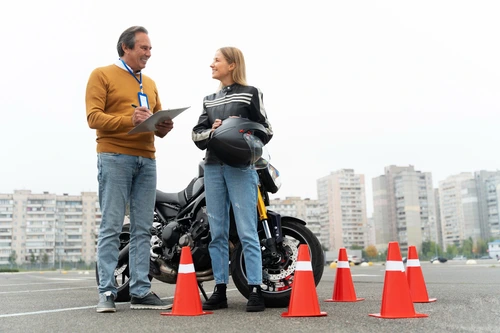
Why Two-Wheeler Defensive Riding Is a Different Discipline from Four-Wheeler Training
Defensive driving programmes for four-wheelers cover SIPDE, following distance, and lane discipline — skills that matter but that assume a vehicle with four points of contact, a protective cage, and standard braking systems. Two-wheeler defensive riding must cover an entirely different set of skills: body position through corners, combined braking technique to prevent low-side falls, managing the buffer zone in mixed traffic where vehicles are far larger, and recognising and surviving the specific hazard combinations that put two-wheeler riders on the ground.
India's road conditions add further specificity. Pothole avoidance at speed, monsoon traction management, heat fatigue on long field routes, and the particular challenge of junctions where two-wheelers are consistently overlooked by turning vehicles — these are not covered in generic road safety awareness programmes.
NIST Global's Defensive Riding Training for Two-Wheelers uses the SEF framework (Space, Eyes, Flow) as the core riding discipline, the T-CLOCS pre-ride inspection as the vehicle readiness protocol, and scenario-based case studies drawn from actual Indian road incident patterns. It is a programme built specifically for corporate field riders — delivery personnel, service technicians, sales executives, and security staff — not a generic motorcycle safety course.
The SEF Defensive Riding Framework — Three Disciplines Active on Every Journey
SEF is not a checklist. It is three continuous management disciplines that a trained rider operates simultaneously throughout every journey — regardless of distance, speed, or familiarity with the route.
Space management is the foundational survival discipline for two-wheeler riders. Unlike a car driver who can absorb a minor impact in a protective structure, a two-wheeler rider who runs out of space goes down. Space management operates in three dimensions simultaneously: the space ahead (following distance), the space beside (lateral buffer), and the space behind (awareness of following vehicles). Following distance for two-wheelers uses a minimum 2-second rule — extended to 4 seconds in wet or congested conditions. This is not conservative — at 60 km/h, 2 seconds = 33 metres, the minimum braking distance needed for a trained rider on dry tarmac. Lateral buffer management means actively avoiding the blind spot zones of larger vehicles (the zone alongside and just behind a bus or truck where the driver cannot see you in any mirror), maintaining distance from the kerb to avoid pothole strikes and door-opening hazards, and positioning within the lane to maximise your visibility to ahead traffic at junctions. Lane position is not a fixed point — a defensive rider adjusts their position within the lane continuously to maintain sight lines and buffer zones.
- Minimum 2-second following gap on dry roads; 4 seconds in wet, heavy traffic, or fatigue
- Never ride in the blind spot zone alongside trucks or buses — pass quickly or drop back
- Maintain 1 metre from the kerb — pothole strike zone and door-opening hazard zone
- Position in lane to maximise your visibility to approaching traffic at junctions
- Identify an escape route before you need it — always know where you would go in an emergency stop
- Double your following distance when riding behind vehicles that obscure your view ahead
- Never tailgate regardless of traffic pressure — two-wheeler reaction distance is unforgiving
Two-wheeler riders face a specific visual hazard not experienced by car drivers: target fixation — the neurological phenomenon where the brain steers the body toward whatever the eyes are focused on. In a panic situation, a rider who looks at the obstacle they are trying to avoid will ride into it. Training the eyes to scan ahead, look for gaps, and focus on where you want the motorcycle to go (not where you fear it will go) is a survival skill that must be practised. Eyes scanning operates on three levels simultaneously: far horizon scanning (12+ seconds ahead) to identify developing hazards early enough to respond without emergency braking; mid-range scanning (4–8 seconds) for traffic state, junction activity, and emerging road surface hazards; and near-field awareness for immediate obstacles, pedestrians stepping out, and vehicle behaviour changes. Mirror discipline is equally important: mirrors should be checked every 5–7 seconds, before every lane change, and before every braking event — rear-end collisions are a significant two-wheeler fatality pattern, and a rider who does not know what is behind them cannot make safe braking decisions.
- Scan 12 seconds ahead minimum — identify hazards before they require emergency response
- Check mirrors every 5–7 seconds and before every speed change or lane movement
- At junctions — look left, right, left again before proceeding; do not assume right of way
- Practise anti-target-fixation: look at the gap, not the obstacle
- Scan road surface ahead for potholes, diesel spills, wet paint, metal covers
- Watch the front wheels of parked vehicles — they indicate an about-to-move hazard
- In monsoon — scan road surface for standing water and tyre tracks from other vehicles
Flow management is the discipline that makes a two-wheeler rider predictable and smooth — the two qualities most associated with crash avoidance. An unpredictable rider — one who accelerates and brakes abruptly, changes lanes without pattern, or varies speed erratically — is a rider that other road users cannot anticipate, which means other road users cannot adjust for them. Flow management means matching speed to actual conditions (road surface, traffic density, visibility, and weather) rather than the posted limit or peer pressure from surrounding traffic; modulating speed changes smoothly using a combination of throttle, engine braking, and progressive brake application rather than abrupt inputs; and maintaining a consistent, predictable riding line that allows following and adjacent vehicles to anticipate your position. Smooth controls are also directly associated with mechanical stability on two wheels — abrupt throttle or brake inputs in corners or on poor surfaces are a direct low-side crash mechanism. The trained rider uses smooth inputs as a stability tool, not just a comfort preference.
- Match speed to road surface condition — not posted limit; reduce early in monsoon
- Use engine braking progressively before reaching a braking point — avoid late, hard braking
- Smooth throttle through corners — never brake mid-corner unless unavoidable
- Maintain consistent riding line — other road users can only predict you if you are predictable
- Avoid speed differentials that make you invisible — extreme speed or extreme slowness both increase risk
- Use appropriate gear for road speed — engine braking is only available in gear
- Do not ride to the capability limit of the machine — ride to the capability limit of your vision and space
Analysis of two-wheeler crash data in India consistently identifies five moments where the probability of a serious incident is highest — and where SEF discipline must be at its most deliberate. Junctions are the single highest-risk location: the majority of fatal two-wheeler collisions occur at junctions where a turning vehicle fails to see the rider. The trained rider approaches every junction at reduced speed, in a gear that allows immediate acceleration, with eyes scanning for turning vehicles even when they have right of way. Overtaking carries specific risk on two-lane roads where head-on collisions are the outcome of miscalculated overtake gaps. Night riding reduces visibility of road hazards and reduces the two-wheeler rider's visibility to other road users simultaneously. Fatigue is particularly acute for field riders on long daily routes in summer heat — it degrades all three SEF disciplines silently and progressively. Understanding these five moments and applying a deliberate SEF response at each is the primary outcome of this training programme.
- Junctions — reduce speed, cover brake, assume you are not seen, scan all approach angles
- Overtaking — minimum 3× the length of the vehicle being passed; check mirrors; signal; acceleration reserve available
- Cornering — slow before the corner, not during it; look through the curve; smooth throttle from apex
- Night riding — reduce speed; increase following distance; use high beam outside built-up areas
- Fatigue — recognise 4 early signs: yawning, delayed reaction, drifting, missing hazards; stop every 90 minutes on long routes
T-CLOCS — The Pre-Ride Inspection Every Corporate Rider Must Complete
Mechanical failure is not the primary cause of two-wheeler crashes — but a tyre at 50% pressure or brakes with insufficient fluid can turn a recoverable situation into a fatal one. T-CLOCS takes under three minutes.
Tyre condition is the single most important safety factor for a two-wheeler rider. The entire vehicle's braking, cornering, and stability performance depends on two small contact patches with the road surface — each roughly the size of a human hand. Under-inflated tyres increase rolling resistance (raising fuel consumption), reduce cornering stability, generate heat that accelerates tyre degradation, and dramatically worsen wet-weather braking performance. Over-inflated tyres reduce the contact patch size, increasing the risk of skidding and reducing ride stability on uneven surfaces. Correct tyre pressure is vehicle-specific — check the manufacturer's specification on the swingarm or owner's manual, not the tyre sidewall maximum. Tread depth should be checked with a coin — if the tread is shallower than 1.6mm (minimum legal depth, 2mm recommended for monsoon conditions), the tyre must be replaced before the next journey. Cracked, bulging, or cut sidewalls indicate structural damage requiring immediate tyre replacement regardless of tread depth.
- Check tyre pressure — front and rear, against manufacturer specification
- Inspect tread depth — minimum 1.6mm, 2mm+ recommended for monsoon riding
- Check tyre sidewalls for cracks, bulges, cuts, or embedded objects
- Inspect wheels for bent rims, damaged spokes (wire wheels), or cracks
- Check wheel bearings for excessive play — grasp the wheel and check for lateral movement
- Remove any stones, nails, or debris embedded in the tread before starting
Controls checks verify that all the rider-operated systems — brakes, throttle, clutch, and gear selector — operate correctly and return to their neutral position when released. Brake lever free play is the most critical: both front and rear brake levers should have 2–3mm of free play before resistance is felt; less than this indicates a need for adjustment; more indicates excessive cable stretch or hydraulic fluid loss. Throttle must snap back immediately when released — a sticking throttle is a direct crash hazard. Clutch operation should be smooth through the full lever travel. All cables should be routed correctly without kinks or chafing on moving parts — a kinked cable can jam at any time. For hydraulic brakes, check that the lever feels firm rather than spongy — a spongy feel indicates air in the hydraulic system, which reduces braking effectiveness and requires bleed or fluid replacement before the vehicle is safe to ride.
- Front brake lever — correct free play (2–3mm); firm feel for hydraulic systems
- Rear brake lever/pedal — correct free play; smooth operation through full travel
- Throttle — snap-return when released; no sticking at any position
- Clutch lever — smooth through full travel; correct free play
- All cables — no kinks, fraying, or chafing; correctly routed through all steering angles
- Gear selector — all gears engage cleanly; neutral locates reliably
Two-wheelers are already less visible than other road users — a non-functioning headlight or missing indicator makes an already difficult visibility problem significantly worse, and is an infringement under the Central Motor Vehicles Rules. Headlight function should be checked in both low and high beam modes. Tail light and brake light operation should be verified before every ride — brake light failure is not visible to the rider but is a significant rear-end collision risk. Front and rear indicators should flash at the correct rate — a very rapid flash typically indicates a failed indicator bulb on a traditional electrical system. Horn function is particularly important in Indian traffic conditions where it is used as a routine hazard communication tool. The kill switch must operate correctly — a non-functioning kill switch means the engine cannot be stopped quickly in an emergency. For battery health, an engine that cranks very slowly or requires multiple attempts indicates a failing battery that should be tested before a long field journey.
- Headlight — low and high beam both functioning; aim correct
- Tail light — check illumination when ignition is on
- Brake light — check activation with both front and rear brake input
- Front and rear indicators — both sides flashing at correct rate
- Horn — functioning and audible above ambient traffic noise
- Kill switch — confirm it stops the engine when operated
Oil and fluid checks protect both the engine and the rider's braking capability. Engine oil level is checked on the sight glass on the right-hand side of most modern motorcycles, or with a dipstick on older models — the oil level should be between the minimum and maximum marks with the motorcycle on level ground on its centre stand (or held vertical). Running an engine with low oil causes rapid internal wear and can result in sudden engine seizure — a catastrophic failure that can cause a fall at speed. Brake fluid is equally critical: hydraulic disc brake systems require brake fluid between the minimum and maximum marks on the reservoir; below-minimum fluid indicates either a hydraulic leak (which requires immediate investigation) or worn brake pads (which have displaced fluid into the callipers). Brake fluid that appears dark brown has absorbed moisture and should be changed — moisture-contaminated fluid has a lower boiling point and can cause brake fade under heavy use. For liquid-cooled engines, coolant level in the overflow reservoir should be between the minimum and maximum marks.
- Engine oil level — between min and max on sight glass or dipstick; check on level ground
- Look for oil drips or puddles under the motorcycle — indicates a gasket or seal leak
- Brake fluid reservoir — front and rear; fluid between min and max marks
- Brake fluid colour — clear to pale yellow is healthy; dark brown requires replacement
- Coolant reservoir (liquid-cooled engines) — between min and max when cold
- Fuel level — sufficient for planned journey; do not reserve-start in city traffic
Chassis checks verify the structural and suspension integrity of the motorcycle — the components that determine how the bike responds to road surface changes and rider steering inputs. Front suspension fork action should be checked by applying front brake and pressing down on the handlebar — forks should compress and return smoothly without binding, knocking, or oil seepage from the fork seals. Rear suspension should be checked for shock absorber operation and linkage tightness. Steering head bearing play should be checked by holding the front wheel between the knees and grasping the lower fork legs — any lateral movement indicates worn steering head bearings that create instability at speed. Chain tension is critical on chain-driven motorcycles: a loose chain can jump off the sprocket or wrap around the rear wheel at speed; a too-tight chain causes additional wear on the sprockets and gearbox bearing. Chain slack at mid-point on the lower run should be within the specification marked on the swingarm, typically 20–30mm. Chain lubrication should be verified — a dry or rusty chain loses power efficiency and wears rapidly.
- Front forks — compress and check for smooth operation; inspect for oil leaks at fork seals
- Rear suspension — check shock absorber action; no oil leaks; linkage bolts tight
- Steering head bearings — check for lateral play with fork held; none acceptable
- Drive chain — tension within specification; clean; lubricated; no kinks or stiff links
- Chain sprockets — check for hooked or shark-fin tooth profile indicating replacement needed
- Frame — visual inspection for cracks, bends, or weld failures especially after any impact
The stand check is the quickest and most frequently overlooked item in a pre-ride inspection — and a faulty or incorrectly stowed side stand is a direct crash cause. Side stand spring tension must be strong enough to hold the stand firmly in the retracted position when riding — a weak side stand spring can allow the stand to drop down, catch on a road surface irregularity or kerb, and lever the motorcycle onto its left side at any speed. Modern motorcycles have an engine cut-out switch that prevents starting in gear with the side stand down — but this switch can fail, and some older vehicles do not have it. The correct habit is to physically check that the side stand is fully retracted before pulling away, regardless of engine cut-out switch function. Centre stand (where fitted) should be fully retracted and secured before riding — a partially deployed centre stand reduces ground clearance and can contact the road during cornering. Both stand pivot bolts should be tight and the stand should not wobble laterally when operated.
- Side stand spring — strong enough to hold stand firmly retracted at all angles of lean
- Visually and physically confirm side stand is fully retracted before pulling away
- Do not rely solely on the engine cut-out switch — check manually every time
- Centre stand (if fitted) — fully retracted; does not contact ground during normal cornering
- Stand pivot bolts — tight; no lateral wobble when operated
- Stand foot plate — present and in good condition; worn foot plates reduce stand stability
Four Hazard Categories Two-Wheeler Riders Face Daily in India
Training that does not name the specific hazards riders face every day stays theoretical. This programme addresses each category with India-specific scenarios and trained responses.
Target Fixation
The instinct to steer toward what you are looking at. The trained response is to look at the gap — not the obstacle. Practised in scenario drills.
Distracted Riding
Mobile use while riding is a primary cause of two-wheeler incidents. Even hands-free audio degrades hazard detection. Policy and habit both addressed.
Overconfidence & Familiarity
Familiar routes produce the most incidents because familiarity breeds reduced scanning. Trained riders apply the same SEF discipline on known routes as on new ones.
Panic Braking Errors
Grabbing the front brake in a panic is the most common cause of low-side falls. Correct combined braking technique — practised until it replaces the panic instinct.
Junction Turning Vehicles
The leading cause of fatal two-wheeler incidents globally and in India. A turning car fails to see the approaching rider. Trained response: slow, cover brake, position for visibility, never assume right-of-way.
Blind Spot of Large Vehicles
The zone alongside and just behind a bus or truck where no mirror covers. Riding in this zone for extended periods is a high-risk behaviour — pass quickly or drop back to a visible following position.
Pedestrian Behaviour
Pedestrians in India cross at unmarked points, step out from between vehicles, and cross against signals. Trained riders scan ahead of parked vehicles and slow at high-density pedestrian zones.
Road Surface Hazards
Potholes, speed bumps, gravel, diesel spills, and painted markings in rain. Scanning 10–12 seconds ahead allows line adjustments without emergency swerves.
Monsoon Traction Loss
Wet tarmac reduces braking grip by 30–50%. Braking distances must be doubled. Painted markings and metal drain covers reduce grip to near-zero in rain.
Summer Heat & Tyre Condition
High ambient temperatures increase tyre pressure (check cold), degrade rider alertness, and — on poorly maintained tyres — dramatically increase the risk of a blow-out.
Low Visibility — Fog & Spray
Highway fog and rain spray from heavy vehicles reduce visibility to metres. Speed must match visible stopping distance — not habit or the traffic flow around you.
Flood Water & Hidden Potholes
Flood water conceals potholes and drain openings that can stop a wheel immediately. Never ride through water of unknown depth even at low speed.
Riding Fatigue
Fatigue degrades all SEF disciplines simultaneously — scanning narrows, following distance shortens, speed increases due to reduced hazard awareness. Four early signs: yawning, drifting, delayed reaction, missing hazards.
Heat Exhaustion & Dehydration
Field riders on long routes in summer heat can reach mild dehydration before feeling thirsty — which degrades decision-making. Mandatory water stops on long field routes are a safety control, not a comfort option.
Night Riding Risks
Reduced visibility, impaired depth perception, and the tendency to over-ride headlights (travelling faster than the illuminated zone allows stopping). Night riding requires speed reduction and increased following distance.
Medication & Illness
Common medications including antihistamines, blood pressure drugs, and some antibiotics impair concentration and reaction time. Riders must report prescribed medication to management for risk assessment before riding duties.
The 8-Step Safe Corporate Riding Journey
From pre-ride preparation through to post-ride defect reporting — every corporate rider should follow this sequence for every journey, regardless of distance.
T-CLOCS Pre-Ride Inspection
Complete the full T-CLOCS check before the first journey of the day. Document any defects. Do not ride on a vehicle with a safety defect — report and swap.
PPE Check — Helmet, Jacket, Gloves
ISI-certified helmet correctly fitted and fastened. Riding jacket or high-visibility vest. Gloves. Riding boots or firm-soled footwear. No flip-flops, no open-face helmets without visor in rain.
Route Assessment
Check weather conditions for the journey. Identify construction zones, flood reports, or unusual traffic conditions. Plan adequate time — time pressure is a primary cause of speed-related incidents.
SEF Active from Ignition
Space, Eyes, Flow active from the moment you pull away — not just on busy sections. The majority of familiar-route incidents occur because SEF discipline is relaxed on roads the rider thinks they know.
Junction Protocol Every Time
Every junction: reduce speed, cover brake, scan all approach angles, assume you are not visible to turning vehicles. Even at junctions you have used a hundred times. Especially at those junctions.
Mandatory Rest on Long Routes
Stop every 90 minutes on routes exceeding 2 hours. Hydrate. Walk briefly. Fatigue builds silently — by the time you notice it, your scanning and reaction time are already significantly degraded.
Hazard Communication to Management
Report significant road hazards, near-misses, and vehicle defects encountered during the journey. Near-miss reporting is a leading indicator of incident risk — organisations that track it reduce incident rates measurably.
Post-Ride Defect Reporting
Any defects identified during or after the ride — tyre wear, brake feel change, mechanical noise — are documented and submitted for maintenance action before the vehicle is used for the next journey.
DD2W Training Topics — What This Programme Covers
Built around the specific vulnerabilities of corporate two-wheeler riders in India — delivery personnel, field technicians, sales executives — not generic motorcycle safety.
SEF Defensive Riding Framework
Space management, Eyes scanning, and Flow management — the three continuous disciplines that operate simultaneously on every journey. Practised in scenario-based exercises, not just explained.
T-CLOCS Pre-Ride Inspection
Tyres, Controls, Lights, Oil, Chassis, Stand — the six-category inspection system covering every safety-critical system. Takes under three minutes. Documented for fleet maintenance records.
Braking Technique & Panic Stop
Combined braking technique for non-ABS and ABS-equipped motorcycles. Why the instinctive panic response (front brake grab) causes low-side falls, and the practised replacement response.
Cornering Body Position & Line
Entry speed, body position, lean angle, throttle management through the corner, and look-through technique. The specific errors — braking mid-corner, target fixation — that cause low-side and high-side crashes.
Monsoon & Adverse Weather Riding
Wet tarmac braking adjustment, rain spray and visibility management, pothole navigation in flood conditions, hot weather tyre pressure management, and fog/low visibility highway techniques.
Helmet Standards & MV Act Compliance
ISI/BIS helmet certification requirements, fit and fastening technique, visor maintenance, high-visibility vest for field riders, and Motor Vehicles Act 1988/2019 Amendment rider obligations and employer duty of care.
What Participants Can Do After This Training
Competency-based outcomes — what every trained corporate rider should be able to demonstrate independently after completing this programme.
Complete T-CLOCS in Under 3 Minutes
Execute the full T-CLOCS pre-ride inspection independently, identify defects correctly, and apply the correct decision — ride, adjust, or report for maintenance — for each defect type found.
Apply SEF on Every Journey
Actively manage Space, Eyes, and Flow simultaneously during riding — including on familiar routes where the habit of reduced vigilance creates the highest incident risk.
Perform a Correct Panic Stop
Apply combined front and rear braking progressively in a panic stop scenario — replacing the instinctive front-brake-grab response with the trained technique that prevents low-side falls.
Recognise and Respond to the Five High-Risk Moments
Apply the trained response at junctions, during overtakes, through corners, at night, and during fatigue — the five moments that account for the highest proportion of two-wheeler crash causation.
Adjust Riding for Monsoon and Adverse Weather
Apply the specific adjustments required for wet tarmac braking, low-visibility riding, pothole-concealing flood water, and summer heat fatigue — without being prompted by training recall.
Comply with Helmet and PPE Requirements
Select, fit, and fasten an ISI-certified helmet correctly; identify non-compliant helmets; apply the full PPE set for field riding; and understand the MV Act obligations and employer policy requirements.
Why Employers Invest in Two-Wheeler Defensive Riding Training
Every field rider represents the organisation on the road. The cost of an untrained rider is not just the incident — it is the injury, the investigation, the insurance claim, and the absence.
Reduces Field Rider Fatalities & Injuries
Two-wheeler training directly reduces the frequency of the behaviours — panic braking, junction misjudgement, fatigue riding — that cause the most severe incidents among corporate field riders.
Drives Helmet & PPE Compliance
Training that explains the biomechanics of head injury and demonstrates correct helmet fitting changes behaviour more effectively than policy mandates alone. Helmet compliance is the single highest-impact safety intervention for two-wheeler riders.
Eliminates Panic Braking Falls
The low-side fall from front brake grab in a panic is a trained-out crash type — it is almost entirely preventable with correct braking technique practice. Removing this pattern from a rider cohort measurably reduces crash frequency.
Monsoon-Specific Skill Building
Generic road safety training does not cover wet tarmac braking adjustment, pothole-in-flood-water navigation, or rain spray visibility management. This programme does — because India's monsoon season creates a predictable, preventable spike in two-wheeler incidents every year.
Fatigue Recognition for Field Riders
Field riders on long daily routes in summer heat experience fatigue-related degradation without recognising it. Training that names the four early signs and provides a practical rest protocol gives riders a tool to protect themselves.
Pre-Ride Inspection Culture
T-CLOCS practised as a daily habit creates a fleet of field riders who detect developing mechanical defects — tyre wear, brake feel change, loose fasteners — before those defects cause an incident, rather than after.
Motor Vehicles Act 2019 Amendment
The 2019 Amendment significantly increased penalties for traffic violations and employer liability exposure. Corporate organisations whose employees ride two-wheelers for work-related duties have a documented duty of care obligation — training records are the evidence of compliance.
Factories Act 1948 Road Journey Obligations
Work-related road journeys — including field service, delivery, and sales trips — are workplace activities under the Factories Act. The employer's duty of care extends to road journeys made as part of the employee's duties.
Insurance Claim Defence
Insurance adjusters and investigators examine training records in all fleet incident claims. Documented rider training — particularly for high-frequency field riders — materially reduces the employer's exposure in claims and litigation.
Helmet Standard Compliance — IS 4151
Training documents that employees have been instructed in IS 4151 BIS helmet compliance requirements. This is evidence of good-faith employer action in the event of a rider fatality where helmet non-compliance is a factor.
Reduced Workers' Compensation Exposure
Two-wheeler incidents are a primary source of workplace injury claims for organisations with field rider workforces. Documented training combined with incident reduction directly reduces the financial exposure to workers' compensation claims.
Contractor & Client Safety Standards
Organisations that supply field riders to client sites are increasingly required to demonstrate rider training compliance as a contract condition. DD2W certification supports pre-qualification and contract compliance documentation.
Reduced Field Rider Absenteeism
Two-wheeler incidents are a leading cause of short and medium-term field staff absence. Training that reduces incident frequency directly reduces unplanned absenteeism and the operational disruption and replacement cost that follows.
Lower Vehicle Repair & Maintenance Costs
Untrained riders wear vehicles faster — through braking technique, tyre management, and mechanical abuse. T-CLOCS adoption combined with smooth riding technique measurably extends two-wheeler service intervals and vehicle lifespan.
Improved Punctuality & Route Reliability
Trained riders manage fatigue, plan routes, and recognise hazards before they require emergency responses — which means fewer unplanned stops, fewer minor incidents, and more reliable journey time performance for field operations.
Sector-Customised Training
NIST Global tailors DD2W training to the specific vehicle types (motorcycles vs. scooters), routes (urban delivery vs. rural field service), and hazard profiles of each client organisation — so the training is directly applicable the next day.
Fuel Efficiency & Sustainability
Smooth throttle management, correct tyre pressure maintenance, and engine braking use combine to reduce fuel consumption by 8–12% for trained riders — measurable at fleet scale for organisations with large two-wheeler field forces.
Corporate Reputation & Brand Safety
Field riders are visible brand representatives. A trained, helmeted, disciplined rider in company livery communicates professionalism. An incident involving an unprotected field rider on an unmaintained vehicle communicates the opposite.
Riding Skills That Outlast the Training Day — Because India's Roads Don't Wait
Every NIST Global DD2W programme combines case studies from real Indian road incidents, hands-on T-CLOCS practice, braking technique drills, and live scenario-based SEF application.
NIST Global by the Numbers
Our Impact Speaks for Itself
Measurable outcomes across 500+ organisations — because a world-class safety culture is built on data, not assumptions.
Who Needs Two-Wheeler Defensive Riding Training?
Any employee who operates a motorcycle or scooter as part of their role — from daily delivery riders to occasional field visitors — is a two-wheeler incident risk that this training directly addresses.
Delivery Executives & Last-Mile Riders
The highest-frequency two-wheeler riders in any organisation — on the road for most of the working day, under time pressure, in congested urban traffic. The highest-risk cohort.
Field Service Technicians
Engineers and technicians riding to customer sites, remote locations, and construction zones — often on unfamiliar roads, carrying tools, with time-pressure-induced hurry.
Sales Executives & Relationship Managers
Field sales staff covering territories on two-wheelers — long daily mileage, unfamiliar roads, and the fatigue of a client-facing schedule on top of riding demands.
Security & Patrol Riders
Site security and patrol personnel covering large areas on two-wheelers — often at night, often on poor internal road surfaces, often with poor lighting.
Plant & Facility Internal Riders
Two-wheelers used for intra-site movement at large manufacturing, logistics, or utility facilities — where traffic, machinery, and pedestrians share road space without the discipline of public roads.
Newly Inducted Field Employees
New joiners assigned to field roles involving two-wheeler use — who hold a licence but have not received professional rider training calibrated to corporate field riding conditions.
DD2W Training Delivered Across Every Field-Rider-Intensive Sector
NIST Global customises two-wheeler training to the specific vehicles, routes, time pressures, and hazard environments of each client industry.
Logistics & Delivery
Telecom & Utilities
Healthcare & Pharma
Manufacturing
Construction & EPC
BFSI & Field Sales
Oil & Gas
Power & Renewables
Complete Your Organisation's Road Safety Training Programme
Two-wheeler and four-wheeler training together cover the full corporate fleet — with consistent SEF and pre-ride inspection discipline across all vehicle types.
Questions About Two-Wheeler Defensive Riding Training
Further Reading on Two-Wheeler Safety & Corporate Field Rider Risk
Practical knowledge from NIST Global's road safety specialists on rider behaviour, incident patterns, and fleet management.
Why 80% of Two-Wheeler Crashes Are Rider Behaviour — Not Bad Luck
An analysis of India's two-wheeler crash causation data and the specific behaviours — panic braking, junction misjudgement, fatigue riding — that trained riders eliminate.
Read article →Monsoon Season & Two-Wheeler Incidents: The Annual Spike and How to Prevent It
Why the onset of monsoon predictably increases two-wheeler incident rates among corporate field riders — and the specific pre-monsoon training interventions that flatten the curve.
Read article →MV Act 2019 Amendment: What Corporate Employers with Field Riders Need to Know
The employer duty-of-care provisions, increased penalties, and documentation requirements that affect any organisation whose employees ride two-wheelers as part of their duties.
Read article →Build a Field Rider Workforce That Comes Home Every Day
Tell us about your field rider fleet — vehicle types, typical routes, and the specific hazards your riders face — and we'll design a Defensive Riding Training programme that directly addresses them. Delivered on-site across India, with content in your riders' language.
- ✓SEF riding framework — Space, Eyes, Flow — practised in scenario drills
- ✓T-CLOCS pre-ride inspection — hands-on with actual fleet vehicles
- ✓Braking technique — combined braking and panic stop practice
- ✓Monsoon and adverse weather riding — India-specific scenarios
- ✓ISI helmet standards and PPE compliance — fit and fastening practice
- ✓MV Act 1988 / 2019 Amendment compliant
Prefer to call directly?
+91 87544 65588