
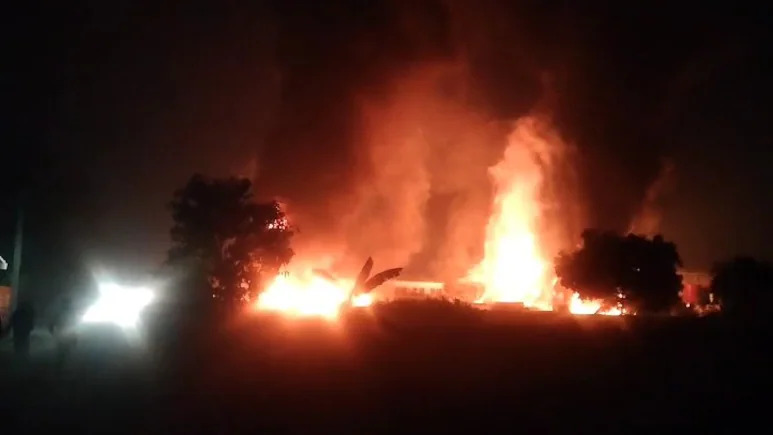
In Greater Noida’s industrial complex, Ecotech-3, a large electronic chip factory had a major fire in the early hours of 4th August 2026, killing two firefighters and injuring three others.
According to reports, the fire broke out at the ILGIM electronic chip manufacturing facility late Monday night. At least six fire engines were deployed after authorities received information about the blaze. Firefighters began operations to bring the fire under control.
Firefighting Operation Turns Fatal
As fire crews were working the fire, a side wall of the factory collapsed, along with an iron beam. The incident resulted in the injury of five firefighters, and they were rushed to a local hospital.
Senior police officers and teams of State Disaster Response Force (SDRF) also were on the spot as rescue and safety operations went on.
The cause of the fire has not yet been established, and authorities are investigating the incident.
What This Incident Highlights About Industrial Fire Safety
Beyond the obvious fire hazard, there may be several other hazards from an industrial fire. During the firefighting effort, the wall and structural component collapsed and illustrates the changed conditions during an emergency.
Fire safety planning should take the following factors into account for organisations that have industrial facilities:
1. Structural Safety During Emergencies
Buildings and industrial structures can become unstable when exposed to intense heat or fire. Emergency response plans should consider the potential for structural deterioration and collapse.
2. Fire Risk Assessment
Fire risk assessments should identify potential ignition sources, combustible materials, fire loads, building characteristics and the effectiveness of existing fire protection measures.
3. Emergency Response Preparedness
Emergency response procedures should clearly establish roles, communication channels, evacuation arrangements and coordination between facility personnel and external emergency responders.
4. Fire Protection Systems
Fire detection, alarm, suppression and firefighting systems need to be appropriately designed, maintained, inspected and tested to ensure they are ready when required.
5. Regular Drills and Training
Emergency procedures cannot remain only on paper. Regular drills and appropriate training help employees understand how to respond safely when conditions change rapidly.
A Reminder for Industrial Facilities
The Greater Noida incident is a tragic reminder that fire safety is not limited to preventing ignition or extinguishing flames. Emergency responders and workers can face additional risks from structural instability, smoke, heat, hazardous materials and changing site conditions.
Organisations should therefore take a holistic approach to fire and life safety—covering prevention, preparedness, response and recovery.
At NIST Global, Fire & Life Safety Audits help organisations identify potential fire and life safety gaps and strengthen their overall emergency preparedness.
The objective is not simply to respond when a fire occurs, but to build a workplace where risks are identified and controlled before an emergency happens.