
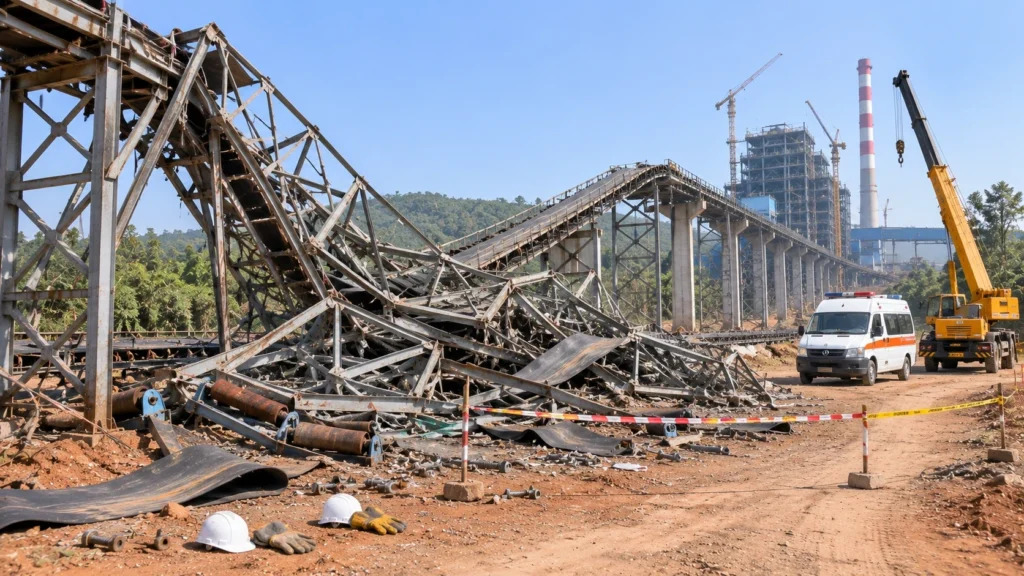
A tragic incident at a thermal power project in Tandwa, Chatra district, Jharkhand, on 18 November 2026, has brought construction safety risks at large industrial infrastructure projects into focus. An under-construction conveyor belt structure collapsed during ongoing work, resulting in the deaths of three contract workers and injuries to two others.
The incident occurred while workers were involved in conveyor system construction. Emergency response and medical assistance were provided to those affected, and an investigation was initiated to establish the circumstances surrounding the collapse. The exact cause has not yet been officially confirmed.
Although the investigation is ongoing, the incident highlights the importance of structural stability, construction planning, temporary works management and effective supervision at industrial project sites.
Understanding Construction Risks in Power Sector Projects
Thermal power projects involve several interconnected construction and operational activities, including material handling systems, conveyor installations, structural erection and heavy equipment movement.
These activities can introduce significant risks, particularly when large structures are being assembled or installed. Unlike completed structures, partially erected frameworks may experience changing load conditions, incomplete connections and temporary support arrangements.
Construction-stage stability therefore requires specific attention. Structural integrity, erection methodology and temporary support arrangements should be reviewed before and during critical construction activities.
Effective construction safety management should consider structural design verification, work sequencing, hazard identification, contractor coordination and supervision.
Key Safety Measures for Construction Site Risk Management
1. Structural Stability and Design Verification
Structural components and supporting arrangements should be reviewed against approved engineering specifications. Load conditions, connections, bracing and stability requirements should be verified at relevant construction stages.
2. Proper Management of Temporary Works
Temporary supports, platforms and other construction arrangements should be appropriately designed, approved, installed and inspected. Their condition and suitability should be checked before work progresses.
3. Safe Construction Sequencing
Erection and installation activities should follow an approved methodology. Changes to the planned sequence should be assessed for their potential impact on structural stability and worker safety.
4. Competent Supervision and Contractor Coordination
Critical construction activities require supervision by competent personnel. Responsibilities between project teams and contractors should be clearly established, with effective communication about work methods and associated hazards.
5. Risk Assessment and Site Inspections
Risk assessments should reflect actual site conditions and changing work activities. Periodic inspections can help identify unsafe conditions, verify the implementation of control measures and ensure that corrective actions are addressed.
Strengthening Construction Safety Across Industrial Projects
Construction incidents involving structural failures can have serious consequences for workers and project operations. Preventing such incidents requires more than compliance with basic site safety procedures.
Organisations involved in construction, infrastructure development and power generation should regularly review their safety arrangements, particularly during high-risk activities. Engineering verification, effective supervision, contractor management and systematic safety inspections all contribute to better risk control.
NIST Global provides professional Safety Audit Services to help organisations assess workplace safety arrangements, identify hazards, evaluate existing controls and recognise areas requiring improvement. Through systematic safety reviews, organisations can strengthen their safety management practices and address potential gaps.
Building safer industrial workplaces begins with identifying risks early, verifying control measures and making safety an integral part of every project activity.